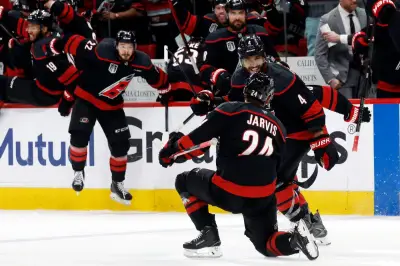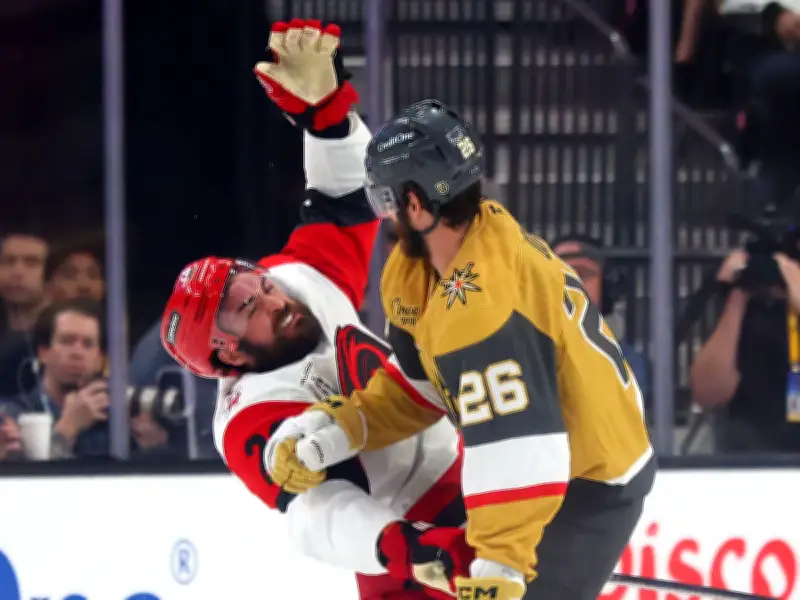
As of this writing, the Stanley Cup finals are tied 2-2, so there is a decent chance they will go the full seven games and finish, in their ESPN-choreographed pas de deux with the NBA finals, on Wednesday, June 17, just beating the summer solstice. In three recent years, the final game has been played after the solstice.
Of course, it has been summer for some time in the homes of the competing teams, Las Vegas (the Golden Knights) and Carolina (the Hurricanes), where recent outside temperatures have been over 100°F and 90°F, respectively, and many fans show up in shorts. The last time Toronto won the Cup, in 1967, the final game was played May 2 at Maple Leaf Gardens. The high was 15°C under partly cloudy skies with light winds and a spattering of rain — in sum, a fine spring day. (Condemn the internet all you wish, but it is a truly miraculous info fount.)
In the 1960s, a non-Canadian team won the Cup just once (Chicago in 1961). Toronto and Montreal took all the rest. But five of the past six Cups have been won, not just by U.S. teams, but by warm-weather U.S. teams (Tampa twice, Florida twice, and Vegas once). The exception was the Colorado Avalanche in 2022. In Colorado, they do still have occasional literal avalanches.

Personnel-wise, though, the finals remain resolutely Canadian. Ten of Carolina's 24-man roster are Canadian, and 16 of Vegas'. That is by birth, however. Many Canadian players end up staying in the U.S., where tax rates are less vindictive toward success. As a result, their sons who make it to the NHL end up playing internationally for the U.S., not Canada. Brawn drain hurts as much as brain drain.
In a study called "Low-tax paths to the Stanley Cup," the Montreal Economic Institute recently argued that Quebec's high tax rates — and the fact Texas, Florida, Tennessee, Washington state, and Nevada do not have personal income taxes — help explain why Montreal has not won since 1993.
One American bucking the high taxes is Lane Hutson, the Montreal Canadiens' defenceman, the "sophomore sensation," as old-time sports writers would have called him, who last year won the Calder Trophy for best rookie. Hutson's post-game interviews as the playoffs progressed — Montreal lost to Carolina in the penultimate round — show just how intense playoff hockey is. His face gradually became tattooed with scratches and cuts. And not from shaving, which the 22-year-old clearly does not do much: his playoff "beard" being playoff tufts. The on-ice post-game interviews of next week's winners will be with pale, bearded, and gaunt, but also ecstatic, survivors of two months of max-stress playoff grind. Many will look like rescuees from the Shackleton expedition.
Maybe the deepest Canadian irony is that a country so proud of its woke devotion to peace-keeping, harmony, co-operation, and non-aggression has a national sport that is so tough, brutal, and violent. The NHL rulebook has eight mentions of "blood," including the stipulation that "high-sticking" merits a four-minute penalty, not two, if injury results, "in the manner of drawing blood or otherwise." A glossary specifies that "blood does not have to be visible to consider it an injury" and that "severe bruising, abrasions, a welt, cutting of the skin, or damage to teeth" also qualify.
How many other sports have rulebooks written partly by pathologists?
In Hollywood's 1940 movie Knute Rockne about the legendary Notre Dame University football coach — in which future president Ronald Reagan plays "win-one-for-the-Gipper" George Gipp, a star halfback who died of pneumonia after the 1920 season — Rockne's character is asked why Notre Dame does not have a hockey program. He says it is because the university's president had told him "Notre Dame will never endorse any game that puts a club in the hands of an Irishman." He does not say anything about Canadians (of which there are seven on Notre Dame's current roster).