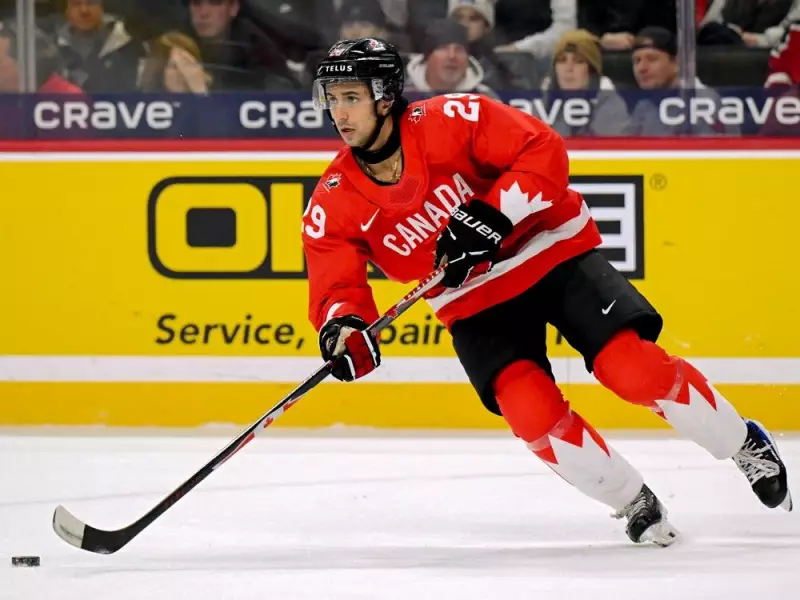
The recent world junior hockey championship in St. Paul, Minn., concluded with a surprising and contentious omission from Team Canada's internal accolades. Despite finishing as the tournament's overall scoring leader, Montreal Canadiens draft pick Michael Hage was not selected as one of Canada's top three players by the team's own coaching staff, led by Dale Hunter.
A Scoring Champion Ignored
The facts of the case are stark. Hage, a centre who bypassed major junior hockey to play for the University of Michigan, tallied more points than any other player at the 2024 world junior championship. Yet, when coaches voted for Canada's top performers, the honour went to teammates Tij Iginla and Sam O'Reilly (each with eight points) and defenceman Zayne Parekh (13 points). Hage's point total, which led the entire tournament, was apparently not enough to secure a spot.
The decision raised immediate eyebrows. TSN analyst Jeff O'Neill publicly questioned the vote, stating, "I have no idea how he wasn't named one of the top forwards for Team Canada. He's been the best player in the tournament. He's unreal." The snub became a focal point after Canada's semifinal loss to Czechia on Jan. 4, 2024, ending their gold medal hopes.

The NCAA vs. CHL Debate Reignited
Many observers, including hockey blogger and journalist Leigh Anne Power, pointed to a potential underlying bias. The three players chosen over Hage all play in the Canadian Hockey League (CHL)—the major junior circuit. Hage, by choosing the NCAA route, represents a different development path that some in Canadian hockey circles have historically viewed with skepticism.
This incident highlights a persistent myth within Canadian hockey: that the CHL is the only true route to the NHL. As noted in the critique, this belief persists despite evidence showing that fewer than two percent of QMJHL players even get a brief stint in the NHL. Meanwhile, NCAA alumni are thriving at the highest level, including current Canadiens like Cole Caufield and Lane Hutson, and top prospect Macklin Celebrini.
The landscape is shifting. New NCAA rules allowing Name, Image, and Likeness (NIL) deals are making U.S. college sports more financially attractive. While hockey isn't at the football level, players can now earn compensation while securing a university education—a combination the CHL, which provides a stipend and scholarship package after playing, structures differently.
Broader Implications for Hockey Canada
The treatment of Hage sends a message to young players weighing their options. As the article argues, if the world junior tournament is a major influence on youth hockey, then the decision-makers at Hockey Canada must modernize their outlook. Snubbing a tournament scoring leader based on his development path is seen as a backward-looking move that could steer talent away from Canadian systems.
The author suggests that players with a scholarship offer should seriously consider the NCAA route. "If you're meant to be in the NHL, you'll make it," he writes, emphasizing that an education provides a crucial safety net for the vast majority who will not reach the professional ranks.
In a related note on current Canadiens, the piece praises the emergence of defenceman Arber Xhekaj, highlighting his evolution into a reliable physical presence who "has reached a point where you hope he doesn't have to fight because he's needed on the ice."
The column concludes with its signature "Heroes and Zeros" list, placing Dale Hunter and his staff in the "Zeros" column for their handling of the Hage situation, while lauding Xhekaj, Martin St. Louis, and others as "Heroes." The core message is clear: for Canadian hockey to build a successful future, it must move beyond outdated biases and embrace all effective development paths.