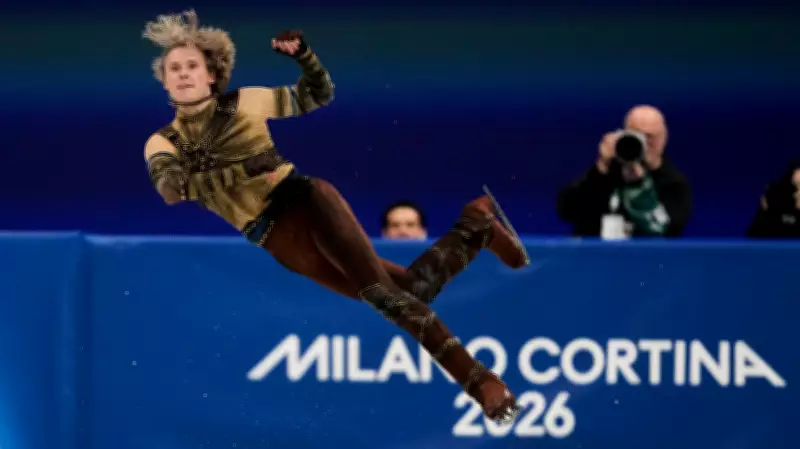
Ilia Malinin's Quad Axel Tease: Olympic Strategy or Calculated Risk?
MILAN (AP) — Ilia Malinin, the American figure skating sensation dubbed the "Quad God," continues to tantalize the Olympic world with his submitted program plans for the Milan Cortina Games. Each submission prominently features the quad axel—a breathtaking 4 1/2-revolution jump so formidable that Malinin remains the sole skater to have ever successfully landed it in competition. Yet, through the gold medal-winning team event and his individual short program on Tuesday night, the audacious jump has remained conspicuously absent from his performances, replaced instead by the safer triple axel that his competitors rely upon.
The Strategic Holdout
"My lazy part of me," Malinin remarked with a knowing smirk, "just forgetting to change the planned elements." However, this explanation may be a playful diversion. With a commanding five-point lead over Japan's Yuma Kagiyama and France's Adam Siao Him Fa entering Friday's free skate, Malinin possesses a substantial cushion that could afford him the luxury of attempting the quad axel, even with the risk of failure. His submitted plan for the evening naturally includes the jump, part of a record-tying seven quads in total.
"I'm hoping that I'll feel good enough to do it," Malinin stated more earnestly. "But of course I always prioritize health and safety. So I really want to put myself in the right mindset where I'll feel really confident to go into it."

The Best Laid Plans
In figure skating, planned program content is precisely that—a plan. Skaters frequently deviate based on their physical condition and performance dynamics. A challenging element in practice or an early mistake in a routine can necessitate on-the-fly adjustments. The quad axel's extreme difficulty stems from the axel being the only one of skating's six primary jumps that initiates facing forward, adding an extra half revolution. Even the triple version poses a significant hurdle for elite athletes.
"I never thought I'd see anybody do a quadruple axel," confessed 1984 Olympic champion Scott Hamilton. "Not in my lifetime." Indeed, many considered it an impossibility until Malinin defied expectations in September 2022. At just 17, during the off-the-radar U.S. International Figure Skating Classic, he executed a near-perfect quad axel in his winning free skate, achieving a spin rate of approximately 340 revolutions per minute—comparable to a ceiling fan on high setting.
A Scoring Behemoth
"Seeing what Ilia has done in the last three years has been mind-boggling," expressed 1994 Olympic champion Kristi Yamaguchi. "I know several of us—Brian Boitano, Scott Hamilton—we've talked, saying, 'We have never imagined we would be alive to see a quad axel performed and landed in competition,' and here comes Ilia, just whipping it off like it's nothing."
It is decidedly something extraordinary. While the triple axel carries a base value of 8.0 points, the quad axel boasts a base of 12.5, plus potential execution bonuses, granting Malinin a massive scoring advantage. At last year's world championships in Boston, he landed it alongside all five other quad jumps, securing his second consecutive title with the second-largest margin of victory in the event's 130-year history.
Why the Hesitation?
Given such prowess, why might Malinin omit the quad axel? Beyond the inherent risk, his programs are already so technically demanding that the jump is not strictly necessary. Kagiyama and Siao Him Fa have each planned only four quads for their free skates on Friday night.
"I want him to be a smart competitor," advised Boitano, the 1988 Olympic champion. "I know how much it can mean to a skater to have a clean performance in the Olympics, and I really want him to have a clean performance. Yes, technical—as technical as he wants to be. But if one of the quads he aspires to hit, he isn't feeling great that day, I want him to be solid."

The Grand Finale Awaits
The son of Olympic skaters Tatiana Malinina and Roman Skorniakov, Malinin thrives on elevating standards. He was among the first to incorporate a backflip into his choreography after the International Skating Union lifted its ban last year, a move that left tennis legend Novak Djokovic in awe during the team competition. Malinin has even crafted his own signature jump, the leaping, twirling "raspberry twist," named for the Russian word "malina," meaning raspberry.
"When I was younger," he explained, "I loved to perform, whether it be I'd turn on some random music at home and just start skating a program that I'd do improv to and try doing triples, even though I could barely do doubles. I was really passionate about the performing aspect of skating, and that's what helps me feel that energy and pressure and almost use it to my advantage."
Malinin acknowledged experiencing heightened pressure during the Olympic team event, where his performances were mediocre by his lofty standards. However, he felt markedly more at ease in Tuesday's short program, reflected in a score of 108.16—less than a point shy of his world-leading mark this season. Now, with one final opportunity to shine at the Milan Cortina Olympics on Friday night, the stage is set for a potential quad axel spectacle, blending strategy, skill, and the relentless pursuit of greatness.