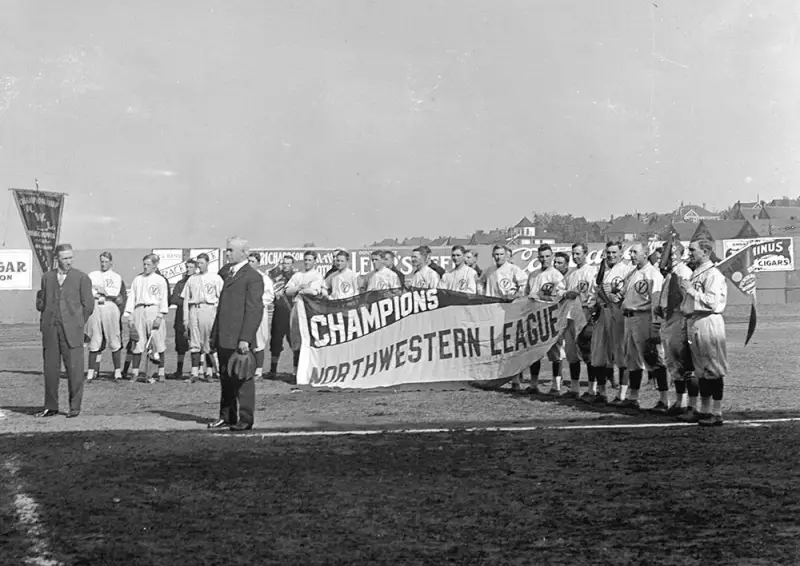
In a move that would resonate through the early history of professional baseball, the Northwestern Baseball League issued a groundbreaking decree on January 3, 1914. The league announced it would impose fines on any player caught using profane language during a game, marking a formal attempt to sanitize the sport's on-field culture.
The "By Gravy" Resolution
A wire story published in The Vancouver Sun covered the league's meeting in Portland, Oregon, with a hint of irony. It reported that directors from the six-team circuit—featuring clubs from Vancouver, Victoria, Seattle, Tacoma, Spokane, and Portland—all emphatically pounded the table and declared, "By gravy, it had to be stopped." The humorous tone, however, soon gave way to the serious rationale behind the new rule.
The primary concern was the proximity of fans to the action. "Under the conditions which exist in this league the stands are all close to the playing field," the report noted, explaining that the "unfumigated language" used by players in moments of high emotion easily reached the ears of spectators in the benches and grandstands. To combat this, umpires were ordered to eject players heard using profane or obscene language, with financial penalties to follow each infraction.

A History of Colorful Language and Enforcement
The original, longer account of the ban, which appeared in the Tacoma Daily Ledger, offered a surprisingly poetic defense of the players' verbal artistry. The anonymous writer acknowledged that some "heroes of the Northwestern circuit" wove a "warp of brilliant, not to say pyrotechnic, language" into everyday speech, creating such a "gorgeous combination" that ordinary talk seemed bland by comparison.
The piece also pointed out that umpires were not innocent bystanders in this culture of cursing. It was widely said among players that Umpire Steve Kane "could cuss for 20 minutes without repeating himself," with his tirades sometimes achieving a rhythmic cadence that put classical poetry to shame.
A Lasting Campaign for Clean Speech
While it's unclear how rigorously the 1914 resolution was enforced in the Northwestern League, it was far from the last attempt to curb swearing in baseball. A search of historical newspapers reveals that in 1919, the Louisville team promised to field "the first swearless baseball team."
Team president William F. Kneblekamp argued that profanity was not only offensive to female fans but also detrimental to performance. "When a player is raving mad he is never so sure to hit a ball or to cleanly field a play," Kneblekamp stated. "Swearing incites such a frenzy. Therefore, since swearing isn't conducive to mental equanimity, why should ball players yield to the temptation?"
These historical episodes highlight a long-running tension in professional sports between raw, emotional expression and the desire to present a family-friendly product. The 1914 ban stands as an early, formal benchmark in baseball's ongoing effort to police the language of its players.