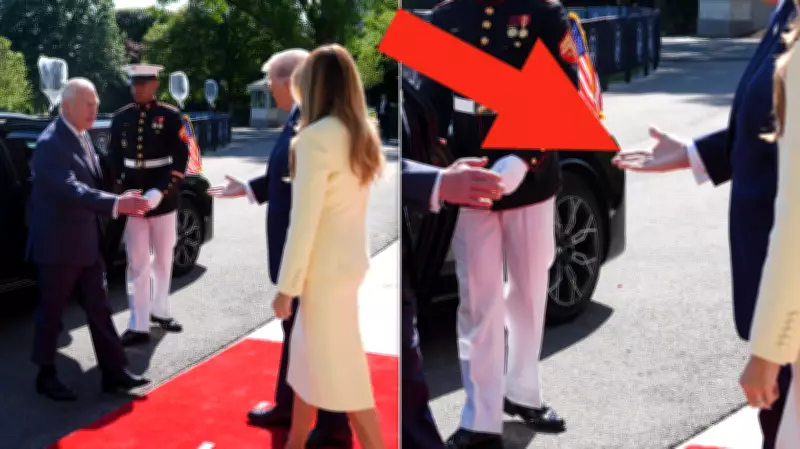
President Donald Trump famously called handshakes a “barbaric” ritual in the years before he became president. Nevertheless, in his career as a politician, he’s been expected to take part — and his handshakes have consistently raised eyebrows.
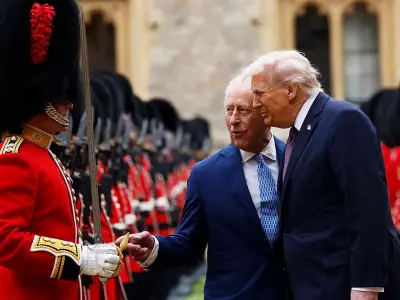
His greeting of King Charles III and Queen Camilla on Monday afternoon for the King’s visit to the United States was no different, with one body language expert referring to the exchange as an all-out “battle” between the two men.
Royal Etiquette Breached
When it comes to royals, there are a lot of rules for how, when and in what manner you’re going to approach them, how and if you make physical contact, etc. “Typically there’s etiquette rules overall, there’s political etiquette and then there’s royal etiquette,” Patti Wood, psychologist, body language and nonverbal communication expert, told HuffPost. “And this breaks all those rules.”

One part of royal protocol we’re seeing Trump not observe, according to Wood, is that “typically the royal decides if they’re going to shake hands and they decide when they’re going to stop the handshake.” So when Trump extends his hand palm up as Charles exits his vehicle, that’s already a departure from those norms because he initiates the gesture.
“The royal etiquette is slightly different in that they’re the ones that typically make the decision,” Wood notes, “because sometimes they just don’t shake hands.”
Interaction with Queen Camilla
Likewise, when Trump greets Queen Camilla, the contact that you see is another departure from the typical interaction between a president and a female royal. Not only did the two shake hands, “but he took his outside hand and gripped her high on the arm,” Wood said. “Now, there can be variations of this as just a soft touch — sometimes people do that because they want to hug, but it’s too formal to hug. But if you look, he’s gripping hard, it’s enough to move her body,” she said. “So that is control. It’s also in terms of royal etiquette, highly inappropriate.”
The 'Trick' Handshake
There’s a “trick” in Trump’s initial gesture. Traditionally, extending an open, palm-up hand is considered a “subordinate” gesture, Wood said. “Typically that’s seen as a subordinate handshake [that communicates] ‘You have more power than me, I’m going to let you be on top,’” she said. However, the way Trump moves after the initial “gracious” gesture reveals a bit more. “He uses it as a trick. He offers it that way, so many people think, ‘Oh, he’s so gracious. Look what he’s doing, how open and receptive,’” she said. “But then he goes into various different battle handshakes.”
This bait-and-switch doesn’t seem to throw Charles off too much, Wood observes. “It’s passive-aggressive because it’s masked in the etiquette of greeting behavior.”
Trump's Signature Moves
Trump’s approach to handshakes (ironically and unironically called an “alpha handshake” depending on who you ask) is often called out as an attempt to “pull the other person off balance,” as Karl Albrecht, an executive management consultant, previously noted in Psychology Today. “This intrusion into personal or intimate space is typically uncomfortable and tension-producing. A downward tug exaggerates the ”‘off balance’ effect.”
“Combined with his official status as U.S. president, this typically — but not always — puts the other person psychologically ‘one down,’ and feeling physically encroached upon,” Albrecht noted. But what happens when the person on the other hand of this move isn’t so cooperative?
The 'Not Let Go' Handshake
Here’s what’s really happening in this “battle” of a handshake. Trump is known for a few signature handshake moves that are noticeable: physically pulling his partner closer during the handshake or controlling the handshake’s length and intensity. In American culture, Wood says the typical handshake is usually “an average of three to five pumps up and down.” And, typically, like a dance, there’s a graceful understanding between the two shaking hands: there’s a monitoring of one another’s behavior and usually it’s a mutual-ish decision when the action is going to end.

That’s not what we’re seeing here. This shake, instead, is what Wood calls the “not let go” handshake. “It’s not smooth, it’s a power grab back and forth,” Wood observed, “you see the hands jet back and forth because Charles is not going to let him win [and] doesn’t want to let him win.” There’s even a moment where Trump takes the hand not shaking Charles’ and taps the other side of his hand, which isn’t an unfamiliar move: “He hits him to get him to let go. It’s very brief, but he hits him,” Wood said. “That’s strategic. He does that in other handshakes. Sometimes he does what’s called a glove handshake where he takes the outside hand and wraps up the other person’s hand, which is a real power move.”
Eye Contact as a Battlefield
Another typical part of “normal” handshakes that this exchange subverts is also the eye contact. Compared to a usual handshake, especially in a ceremonial (and generally friendly) dynamic, this stands out. Typically, eye contact is more brief and the people shaking hands will break away, look at each other’s hands in what Wood calls “sort of a dance of eye contact.”
“I’d say it’s unique that it’s a battle and unique that you can see [Charles] maintain eye contact,” Wood added. “This to me is one of the most dramatic parts about it. They’re making mutual eye contact. They’re doing a stare out.”
As the King’s four-day visit to the U.S. continues, you’ll just have to watch to see how the rest of their “dance” plays out.