

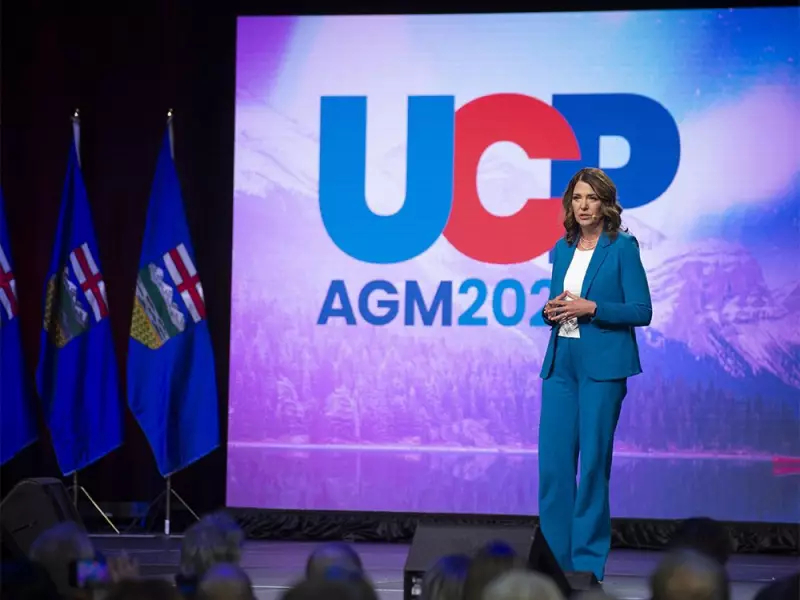
Premier Danielle Smith's recent political victory, a new memorandum of understanding (MOU) with the federal government, was met with a surprising chorus of disapproval from within her own party ranks. The scene unfolded at the United Conservative Party's annual general meeting in Edmonton over the weekend of November 29-30, 2025.
A Chilly Reception at a Friendly Gathering
Instead of a triumphant entrance, Smith faced audible boos from segments of the crowd when she highlighted the freshly inked agreement with Ottawa. The expected adulation from the party faithful only materialized later in her speech, once she shifted focus to other topics. This reaction underscored a deep-seated tension within the UCP's broad coalition.
The hostile response served as a stark reminder of the sizable separatist contingent present at the gathering. For these members, any deal with the federal government, no matter how favourable, is viewed with deep suspicion. Their hope for a surge in momentum relied on continued conflict and outright rejection from Prime Minister Mark Carney's government.

The MOU: A Strategic Win for Federalism
Despite the vocal dissent, political observers conclude the week was a clear success for Premier Smith and a corresponding defeat for the separatist cause. The Alberta-Ottawa MOU itself represents a major blow to the movement's near-term prospects. The agreement, seen as advantageous for Alberta, deprives separatists of the anger and frustration that would have fueled their campaign following another federal refusal.
Analysts suggest Prime Minister Carney was motivated to secure the deal either due to genuine concern over national unity tensions in Alberta or, more pragmatically, a recognition of the province's critical role as an economic engine during a national crisis. Either interpretation frames the MOU as a win for pragmatic federalism.
Separatist Sentiment Stalls, But Influence Remains
While the deal has dampened the separatist wave, the movement retains the capacity to create internal challenges for Smith and the UCP. However, their efforts to pass significant separatist-leaning resolutions at the AGM were unsuccessful. The path to achieving anything close to majority support for independence, always a steep climb, has grown even more difficult.
Recent electoral history supports this analysis. Separatist parties have been non-factors in recent provincial and federal byelections, failing to gain meaningful traction with the broader electorate. A future collapse of the Alberta-Ottawa agreement could theoretically re-energize the movement, but the interim period risks leaving it politically moribund.
The episode at the UCP AGM reveals a premier walking a careful line: securing concrete agreements for Alberta while managing a party base where anti-Ottawa sentiment remains a powerful, if electorally limited, force.






