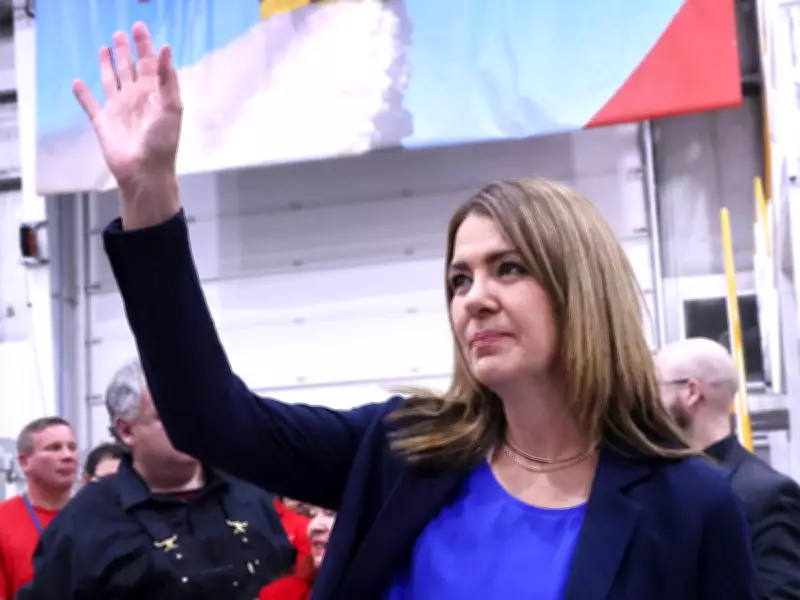
In a definitive statement addressing concerns about Alberta's political stability, Premier Danielle Smith has firmly declared that discussions regarding a potential vote on Alberta independence are not influencing investment decisions within the province. During a recent announcement of a $400 million deal to acquire water bombers from De Havilland Aircraft of Canada in Calgary, Smith emphasized that major investors remain focused on practical business factors rather than separatist politics.
Investor Priorities: Permits and Timelines Over Politics
When questioned about reports that uncertainty surrounding a possible independence vote this fall is stalling pipeline investment, Smith responded with a single word: "Untrue." She elaborated that in her conversations with significant financial backers, the topic of Alberta separating from Canada simply does not arise. Instead, investors are primarily concerned with operational efficiencies and economic conditions.
"I'm telling you it doesn't come up when we're having these major conversations with big investors," Smith stated, listing prominent companies such as Dow Canada, De Havilland, WestJet, multiple data centers, and Lufthansa among those engaging with her government. "What does come up is: Can we get the permits? What is the timeframe for a final investment decision in order to be able to get shovels in the ground?"

Creating a Favorable Investment Climate
The premier highlighted her administration's efforts to establish what she describes as "a streamlined regulatory system" and "the best tax system in North America" to attract capital. She identified these elements as the most influential factors for investors, overshadowing any political debates about Alberta's future within Confederation.
"That to me seems to be the most influential factor," Smith remarked, underscoring the province's commitment to improving its business environment. She pointed out that Alberta is actively working to rectify past investment challenges, which she attributes largely to federal policies.
Pipeline Challenges: Federal Hurdles, Not Separatism
Addressing specific concerns about pipeline projects, Smith acknowledged that obstacles exist but clarified that they are unrelated to independence votes. She cited historical issues where companies invested billions in approvals only to have projects canceled by the federal government, creating a climate of hesitation among potential investors.
"I can tell you what's creating some pause for pipeline companies," Smith explained, referencing the Northern Gateway pipeline project through northern British Columbia, which was "arbitrarily cancelled" by the previous federal government under former Prime Minister Justin Trudeau. She noted that over the past decade, hundreds of billions of dollars in investment have shifted south due to what she characterizes as a "terrible investment climate" influenced by federal decisions.
Looking Forward with Federal Collaboration
Smith revealed that Alberta is currently engaging with the government of Prime Minister Mark Carney, having submitted a pipeline proposal in June with hopes of receiving a "positive sign" that it will be fast-tracked as a project of national interest. She expressed optimism that this approach will encourage proponents to come forward once regulatory certainty is established.
"At that point you will see one or more proponents comes forward," Smith predicted, emphasizing that the core issue is rebuilding trust with investors who have been "bitten many times" by federal policy shifts. Her comments aim to reassure both domestic and international stakeholders that Alberta remains a viable and attractive destination for investment, regardless of ongoing political discussions about its constitutional future.