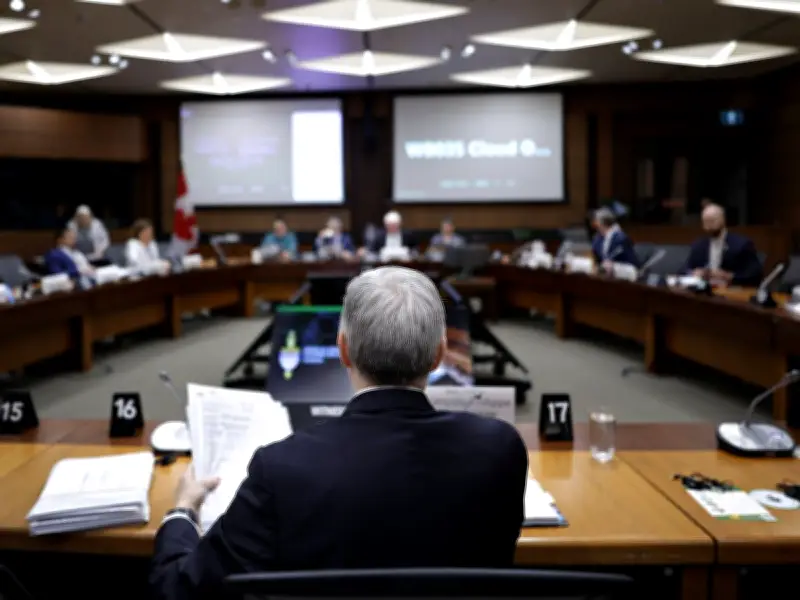
OTTAWA — Finance Minister François-Philippe Champagne faced pointed questions Thursday over his personal connection to the federal government’s high-speed train plan, with opposition MPs accusing the minister of taking part in more than a dozen votes on the lucrative project after he declared a potential conflict.
But Champagne told the House of Commons Ethics Committee that he went beyond the call of duty by writing last September to the prime minister to add a special filter to his conflict-of-interest disclosure after his spouse was hired in August as an executive at Alto.
The organization, which falls under Transport Canada, manages the government’s plan to build high-speed rail between Toronto and Quebec City at a cost of a projected $90-billion.

Champagne had vowed not to participate in any discussions or decisions with government representatives about the proposed high-speed rail project. “I followed all the rules,” he told the committee.
But opposition MPs said Champagne did not follow his own promises when his first budget, two months after adding the filter, included hundreds of millions of dollars for the rail project. That money and the government’s support for the project, however, had been announced months earlier.
The government has said the new rail link, not expected to be completed for more than a decade, will add an important transportation line and will support or create more than 50,000 jobs and add $25 billion to the economy.
Opposition MPs on the committee made repeated requests that Champagne release his letter to the prime minister and his filter to the committee, but he said that is the ethics commissioner’s decision. Conservative MP Gabriel Hardy proposed a motion to compel Champagne to release the documents to the committee, but the Liberal majority voted it down.
Ethics Commissioner Konrad von Finckenstein appeared before the committee Thursday after Champagne and told MPs that he did not post the documents on his office’s web site because the minister’s disclosure was voluntary. Von Finckenstein said the fact that the minister’s spouse works at Alto, a wholly owned subsidiary of the federal government, is not a conflict, largely because the organization falls under the minister of transport.
“It’s simply too remote,” he told the committee.
Duff Conacher, co-founder of Democracy Watch, which advocates for democratic reform, said he does not see this particular situation as a major conflict because the government had already committed to the high-speed rail project before Champagne’s spouse was hired. There has also been no evidence presented that either Champagne or his spouse, Anne-Marie Gaudet, benefited directly from the budget bill or other votes.
But Champagne also raised the ire of opposition MPs by repeatedly deflecting questions, including those that asked for basic facts, such as whether his spouse is an executive at Alto.