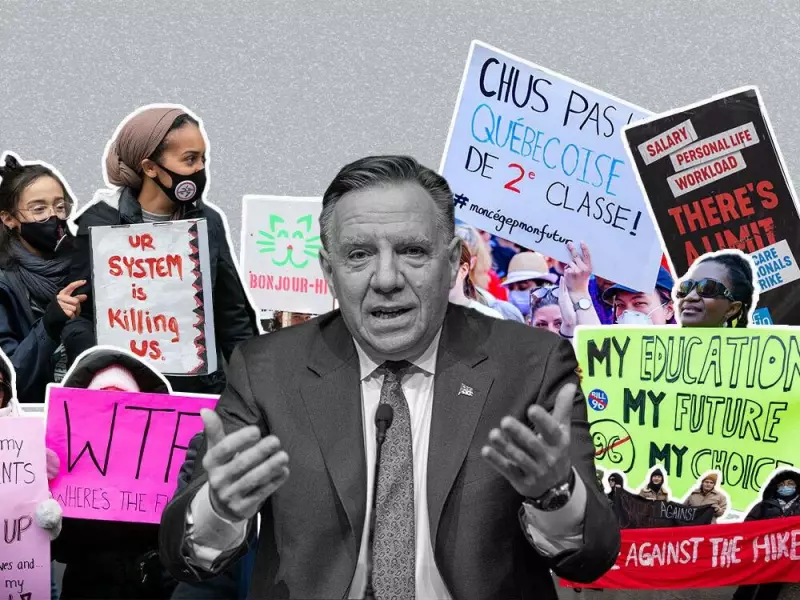
Premier François Legault announced his resignation on Wednesday, January 15, 2026, with a heartfelt declaration of his love for Quebec. Speaking from the marble foyer of the Honoré-Mercier Building in Quebec City, the outgoing leader called serving as premier "the honour of my life." However, the warmth of his parting embrace was not felt equally by all Quebecers, capping a tenure defined by a nationalist agenda that frequently divided the population it sought to unite.
A Legacy of Division, Not Unity
While Legault's Coalition Avenir Québec (CAQ) was initially presented as a break from Quebec's traditional sovereignist-federalist battles, his government became synonymous with a narrow, exclusionary form of nationalism. His efforts to protect the French language and Québécois identity often created a stark divide between "us" and "them." English speakers, immigrants, people of diverse backgrounds, and even Montrealers were frequently made to feel like outsiders in the nation Legault championed.
This dynamic was particularly evident in his government's relationship with Montreal, North America's only major French-speaking metropolis. The CAQ never gained significant electoral support in the city, and Legault's policies often reflected that disconnect. He regularly shortchanged Montreal on funding for public transit and homelessness services. Furthermore, he repeatedly blamed the city for broader provincial issues, from the common use of "Bonjour/Hi" to the presence of anglophone university students and temporary immigrants, whom he cited in his resignation speech as eroding the status of French.

Signature Policies: Secularism and Language Laws
Among the accomplishments Legault highlighted was Bill 21, the secularism law that prohibits public servants in positions of authority from wearing religious symbols. While popular with many Quebecers who view it as a continuation of the Quiet Revolution's separation from the Catholic Church, the law is widely criticized as state-sanctioned discrimination that tramples minority rights. It has survived legal challenges due to the preemptive use of the notwithstanding clause.
Legault's government doubled down on this approach, passing Bill 94 in 2025 to extend the dress code to school support staff and tabling Bill 9 to cover daycare workers and outlaw public prayer. A reckoning is pending at the Supreme Court of Canada.
Similarly, Bill 96, the law to bolster the French language, shattered decades of relative linguistic peace. Despite assurances it would not infringe on anglophone rights, the law has marginalized English-speaking Quebecers through measures like confusing health-care instructions and imposing a six-month French communication deadline for newcomers. It has also systematically weakened English institutions, from attempts to abolish elected school boards to tuition hikes for out-of-province students and enrolment caps at English CEGEPs.
The Shifting Political Landscape and Lasting Impact
Legault's resignation arrives as Quebec's political tectonic plates are shifting ahead of a fall election. The Parti Québécois is surging in polls, the Quebec Liberal Party is leaderless after a scandal, Québec solidaire is fraying internally, and the Quebec Conservative Party is seeking a breakthrough. Now, the CAQ itself must find a new leader to replace its founder.
Legault's undeniable achievement was breaking the old sovereignist-federalist paradigm that dominated for 50 years. By pursuing an incremental, pragmatic nationalism, he spared the province another referendum on separation for seven years. Yet, in fervently defending Quebec's identity and autonomy, he may have laid the groundwork for a future sovereignty vote. Polls show strong support for the PQ, which promises a third referendum, even though a majority of Quebecers still say they would vote against independence.
His political decline followed a series of fiascos, including the failed Northvolt battery plant project, massive cost overruns at the SAAQ, a controversial proposed constitution, a near-implosion of primary care in a showdown with doctors, and the alienation of key cabinet ministers like Lionel Carmant and Christian Dubé.

While English speakers and immigrants will not miss being used as scapegoats, discontent with Legault's leadership has become widespread. The premier who once enjoyed unsinkable approval ratings during the pandemic, winning a second crushing majority in 2022, has reached his political best-before date. His departure marks the end of an era, but the divisive legacy of his nationalism will continue to shape Quebec politics for years to come.