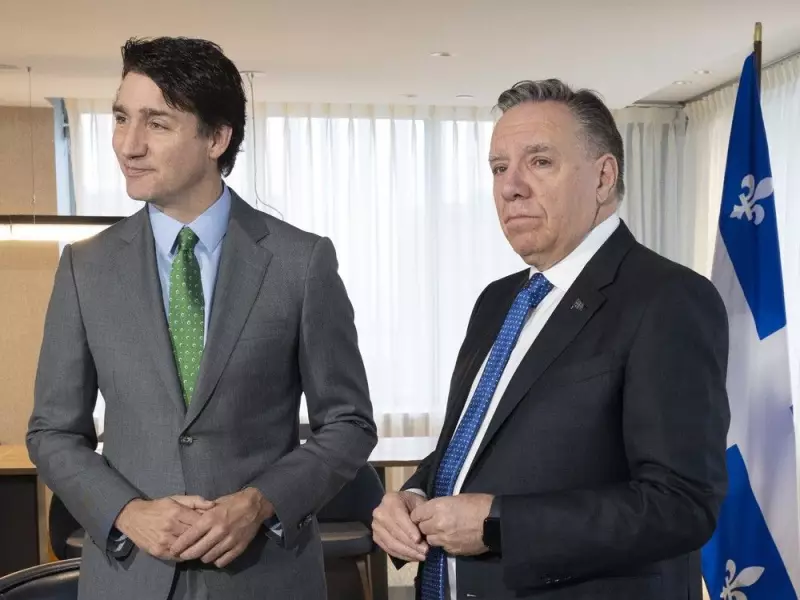
In a stunning political development, Quebec Premier François Legault announced on Wednesday that he will resign as leader of the Coalition Avenir Québec (CAQ). The move comes as his party faces the prospect of a devastating defeat in the provincial election scheduled for October.
A Familiar Political Script
The scenario bears a striking resemblance to federal politics from just a year ago. At that time, a deeply unpopular Prime Minister Justin Trudeau announced he would step down as Liberal leader once a successor was found. Former Bank of Canada governor Mark Carney ultimately replaced him, leading the Liberals to a fourth consecutive term.
However, political observers note a key difference in Quebec's situation: the CAQ does not appear to have a figure of Carney's stature waiting in the wings to take over the leadership.

Why Legault Stepped Down
Legault's announcement coincided with the release of yet another devastating public opinion poll. The Pallas Data survey, conducted for The Walrus, shows the sovereigntist Parti Québécois surging into the lead with 34 per cent support.
The Quebec Liberals, despite currently lacking a permanent leader, hold second place at 24 per cent. The Quebec Conservative Party follows with 16 per cent support. Most critically for the CAQ, the poll shows the governing party tied for fourth place with Québec solidaire at just 11 per cent of voter support.
Philippe J. Fournier, founder of the polling analysis site Qc125, provided a grim assessment. He notes the CAQ is in last place among francophone voters and outside the major urban centres of Montreal and Quebec City. The data suggests the party could be completely decimated in the upcoming election.
On a personal level, Legault has become the most unpopular premier in Canada, according to national tracking.
A Year of Crises for the CAQ Government
The decision to resign follows what can only be described as an annus horribilis for the Legault government in 2025. A series of major setbacks eroded public confidence:
- Historic Deficit: The government tabled a budget with a record $13.6 billion deficit, leading credit agency S&P Global to downgrade Quebec's credit rating for the first time in three decades.
- Costly Tech Failure: Quebec's auditor general revealed a digital modernization project at the province's auto insurance corporation went half a billion dollars over budget. The scandal forced the resignation of the cybersecurity and digital affairs minister and triggered a public inquiry.
- Contentious Legislation: The controversial Bill 2 sparked a revolt among the province's doctors, who threatened to leave Quebec en masse. The bill's adoption and subsequent backtracking on its most divisive parts caused two of Legault's closest ministerial allies to resign.
In his resignation address, Legault stated, "For the good of the party but above all the good of Quebec, I am announcing that I am resigning my role as Quebec premier." He expressed hope that the October election would focus on Quebec's substantive challenges rather than a simple desire for change.
Legault pledged to remain in office until the CAQ selects a new leader. The party's executive was scheduled to meet Wednesday evening to chart a path forward. "Being the premier of Quebec has been the greatest honour of my life," he told the public.
Political Ramifications for Quebec
Legault's departure sends shockwaves through Quebec's political landscape at a precarious moment. The Parti Québécois, riding high in the polls, sees a clear path to power. The Quebec Liberal Party is in the midst of its own leadership search. The resignation creates significant uncertainty, reshaping the entire battlefield for the fall election.
The coming weeks will determine whether the CAQ can rally under a new leader or if Quebec is on the cusp of a major political realignment.