There are all kinds of legitimate criticisms that could be leveled at Alberta’s premier for how she’s navigated the separation debate or the question she’s chosen to place on the October ballot.
More narrowly, one could fairly criticize Danielle Smith for how she’s dealt with First Nations around this issue or how she’s approached the constitutional duty to consult in the face of two court rulings on the matter.
But then there are some criticisms that are just beyond the pale. Others that are completely nonsensical. What emerged this week from treaty chiefs in Alberta managed to check both boxes.

And for all that these First Nations have done to push back against separatism and to draw attention to various aspects of this debate, they have now damaged their own credibility and undermined their own cause.
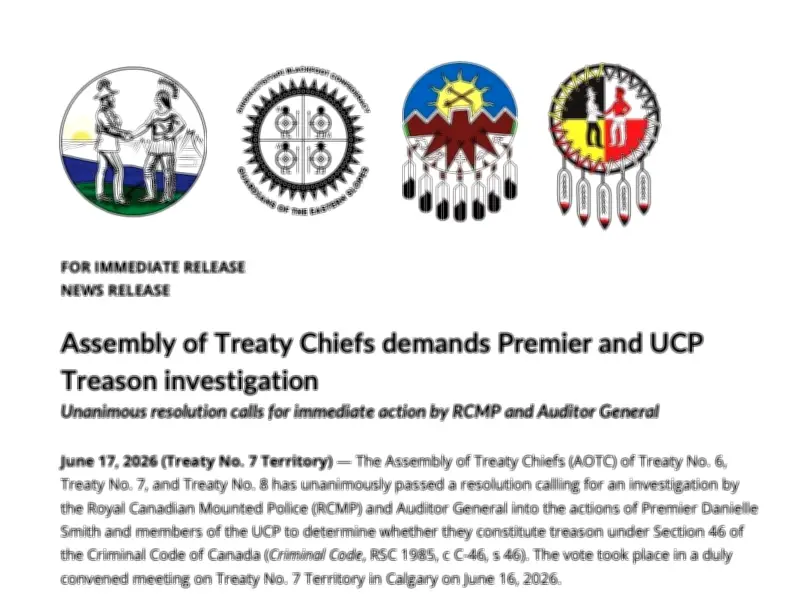
In a news release early Wednesday, the Assembly of Treaty Chiefs (AOTC) of Treaty No. 6, Treaty No. 7, and Treaty No. 8 announced that they’d unanimously passed a resolution calling for the RCMP and the auditor general to investigate Premier Danielle Smith and members of the United Conservative Party for treason.
Yes, treason.
To be clear, it’s been almost 80 years since anyone was charged and convicted of treason in this country, and that was a case far, far removed from any sort of political debate in Canada.
The word “treason” gets thrown around a lot and too many people are far too cavalier in its use. Treason is not a substitute or synonym for “disloyal.” It is a clearly defined and serious crime in the Criminal Code of Canada (section 46), punishable by up to life in prison.
This fact is noted in the AOTC press release, so at least they recognize the gravity of the term. But that only makes their accusation all the more absurd.
For the record, the crime of treason applies to the use of “force or violence for the purpose of overthrowing the government of Canada” or illegally providing information to a foreign government or agent that “may be used by that state for a purpose prejudicial to the safety or defence of Canada.”
None of that is even remotely related to the notion of holding separatist views or even a government allowing a vote on separation. Lest we forget that there is another province in Canada that has already held two votes on separation — with perhaps another to come — and features both a provincial and federal separatist party as permanent political fixtures.
So even if Smith was a separatist and leading a separatist party, that would and should be of little concern to the RCMP or any other branch of law enforcement in the country. It may well be disloyal or unpatriotic to believe in separatism or to reject Canada altogether (does this apply, for example, to those who consider Canada “stolen” and “illegitimate”?), but it is certainly not illegal.