

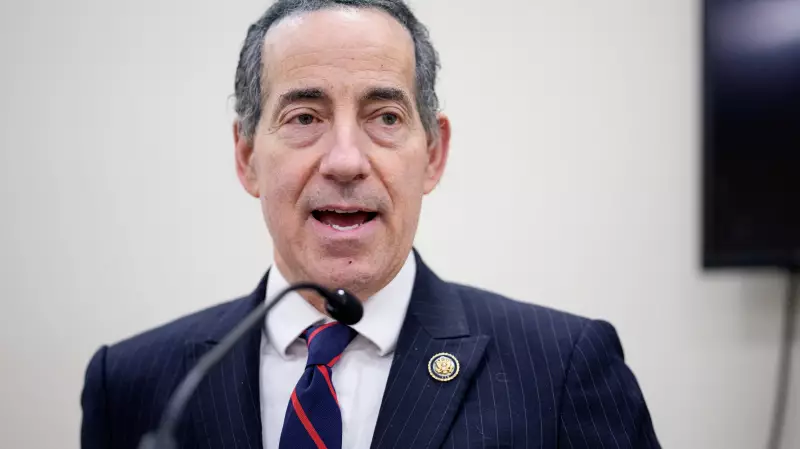
In a fiery television appearance, a prominent Democratic congressman has launched a scathing critique of the U.S. Justice Department's handling of newly released documents related to the Jeffrey Epstein case, alleging the extensive redactions serve as a cover-up to protect former President Donald Trump and his associates.
Nonsensical Redactions and Accusations of a Cover-Up
Speaking on CNN's "State of the Union" on Sunday, Representative Jamie Raskin (D-Md.) argued that the blacked-out sections in hundreds of Epstein files made public on Friday defy logic. He pointed to the statute governing the release, which he said only permits redactions related to specific areas like ongoing child sex abuse investigations, physical abuse, or national security.
"If you read the statute, the only things that are allowed to be redacting are related to child sex abuse, physical abuse, ongoing investigations, which they say there are none, and national security. So how can you block out an entire document? It makes no sense," Raskin told host Kasie Hunt.

Raskin connected the redactions directly to Donald Trump, recalling that the former president initially opposed the legislation mandating the release. "Trump opposed the legislation up until the very end, when he could read the writing on the wall," Raskin stated, suggesting Trump's late support came only after his followers planned to obstruct the law's implementation.
Justice Department Defends Actions, Raskin Sees Political Motive
The release of documents has been a staggered process. While hundreds were published on Friday, CNN reported that the Justice Department has since removed at least 16 files. In a statement on Saturday, the DOJ said it would continue reviewing and redacting the materials to protect victims' identities.
This justification was echoed by Deputy Attorney General Todd Blanche on NBC's "Meet the Press" on Sunday. However, when asked if any redactions legitimately protected victims, Raskin was dismissive. "They have not shown any deference or respect for the victims at all," he asserted.
Instead, Raskin framed the actions as a deliberate effort to conceal information about Trump's circle. "It’s all about covering up things that, for whatever reason, Donald Trump doesn’t want to go public, either about himself, other members of his family, friends, Jeffrey Epstein, or just the social, business, cultural network that he was involved in for at least a decade, if not longer," he said.
Pressed on whether the Justice Department's moves were specifically designed to shield Trump, Raskin responded bluntly: "I mean, that’s their whole business model." He accused the department of reorganizing "American constitutional jurisprudence and the rule of law" around a "unitary executive theory" focused solely on serving Trump's desires.
Potential Legal and Political Repercussions
The controversy is setting the stage for further political and legal battles. Hunt questioned Raskin about potential next steps proposed by some Democrats, such as lawsuits against the Justice Department or even impeaching Attorney General Pam Bondi.
Raskin indicated that litigation is being seriously considered. "If it’s possible, we will be bringing litigation, but we’re trying to work that through right now," he revealed. He added that while "everything is on the table," many solutions require a congressional majority that Democrats currently do not hold.
The debate over the Epstein files redactions highlights deep partisan divisions over transparency, justice, and the perceived politicization of federal institutions, ensuring the issue will remain in the spotlight for the foreseeable future.






