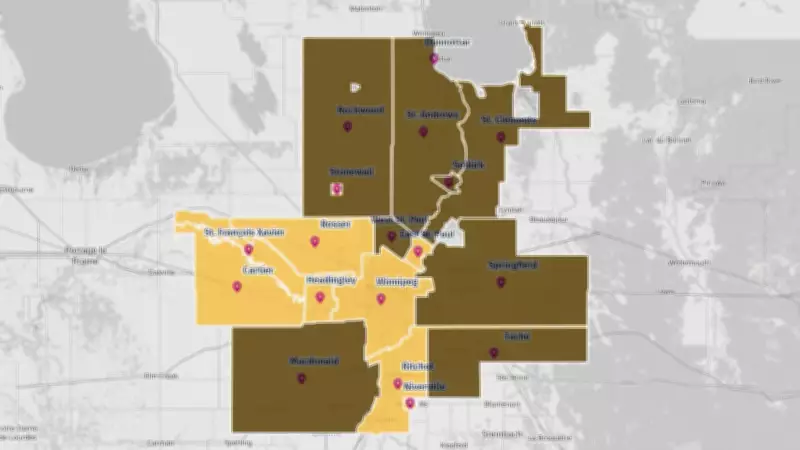
The future of coordinated regional planning in Manitoba's capital area has been thrown into serious doubt following a dramatic exodus of municipal partners. According to recent developments, exactly half of the original eighteen member municipalities have either formally exited or passed resolutions to leave the Winnipeg Metropolitan Region planning group.
A Fractured Foundation for Regional Cooperation
This mass departure represents a significant setback for efforts to create cohesive development strategies across the greater Winnipeg area. The planning group, established to foster collaboration on infrastructure, transportation, housing, and economic development across municipal boundaries, now faces an existential crisis with its membership effectively halved.
The shaded municipalities in organizational diagrams tell a story of fragmentation where once there was intended unity. While specific reasons for each municipality's departure haven't been fully detailed in initial reports, such widespread disengagement suggests fundamental disagreements about the planning group's direction, authority, or perceived benefits to outlying communities.

Implications for Future Development and Governance
Regional planning experts warn that this breakdown in cooperation could have far-reaching consequences. Without coordinated planning, municipalities might pursue conflicting development strategies, potentially leading to inefficient infrastructure investments, duplicated services, and missed opportunities for shared economic growth.
The timing of these departures is particularly concerning as the Winnipeg area faces pressing challenges including housing affordability, transportation congestion, and climate adaptation—all issues that benefit from regional rather than piecemeal approaches.
Historical Context and Current RealitiesThe Winnipeg Metropolitan Region was conceived as a mechanism to address the complex interdependencies between Winnipeg and its surrounding communities. Like many metropolitan regions across Canada, it aimed to create a framework for addressing cross-border issues that individual municipalities cannot solve independently.
This current crisis echoes challenges faced by other Canadian metropolitan regions where tensions between urban cores and suburban or rural municipalities sometimes undermine collaborative governance structures. The departure of half the membership suggests these tensions may have reached a breaking point in the Winnipeg context.
Potential Paths Forward Amid Uncertainty
Several scenarios could emerge from this situation. The remaining municipalities might attempt to continue with a scaled-back version of regional planning, potentially focusing on core areas of agreement. Alternatively, provincial intervention could become necessary to either mediate the dispute or establish alternative governance mechanisms for regional coordination.
Another possibility involves the creation of new, smaller coalitions of municipalities with shared interests, though this fragmented approach would likely sacrifice some benefits of comprehensive regional planning. Whatever path forward emerges, the current crisis has undoubtedly complicated the governance landscape in one of Canada's important metropolitan regions.
The coming months will reveal whether this represents a temporary setback or a permanent reconfiguration of how planning occurs in the Winnipeg area. What remains clear is that the vision of seamless regional cooperation has suffered a substantial blow that will require significant effort and political will to repair.