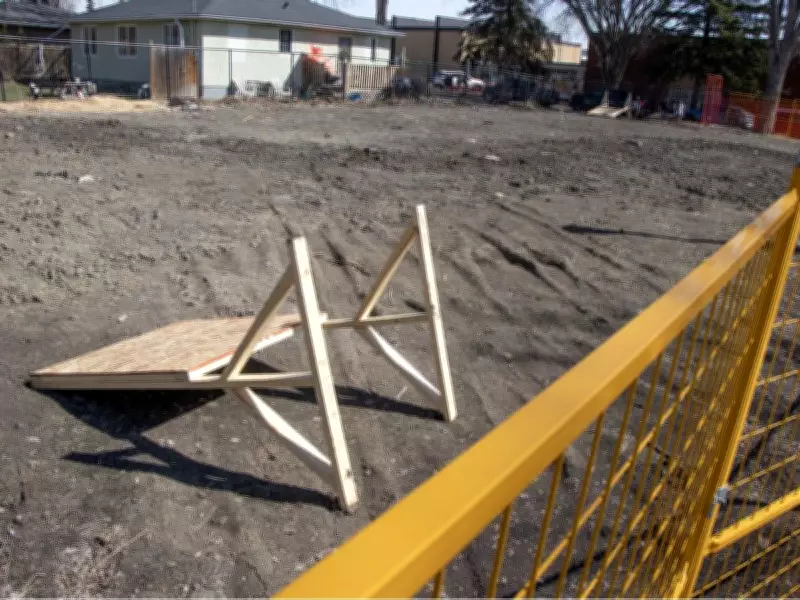
The fate of a proposed infill development in Glenora hangs in the balance after a heated tribunal at city hall on Friday. Residents, including some named on a sign that threatened to build a halfway house next to a school, argued that the developer's permit for 13302 106 Ave. should be revoked. The subdivision and development appeal board is expected to deliver its decision within two weeks.
Appellants' Concerns
Appellants pointed out that the floor plan for the development features three bedrooms per unit, each with its own bathroom. Gwendolyn Stewart-Palmer, representing Progressive Academy, noted that none of the units have significant shared living space beyond a kitchen. She argued that the floor plans are similar to other buildings owned by the developer, many of which are being rented out as single rooms. The fear is that the 10-unit development could effectively become a 30-person rental property.
“The developer’s website is advertising rooms for rent at $850 per month,” Stewart-Palmer said. “The board needs to look at it as a lodging house.”

Additional concerns raised included drainage and grading issues, as the lot sits higher than neighbouring properties, as well as potential problems with waste receptacles, parking, and walkways. Heavy traffic during peak school hours was also cited as a worry.
Developer's Position
James Murphy of Ogilvie Law, representing Glenora Homes, argued that his client would need further permits to use the building for lodging, though he admitted he was unaware of how other Glenora Homes properties are marketed. He noted that the development authority had reviewed and approved the plans without requiring additional studies on drainage, traffic, or grading. The city’s waste management authority also approved the site plan.
Murphy emphasized that there is nothing preventing his client from selling the building after construction, and that the tribunal’s role is to assess the development, not the developer. He suggested that homeowners should direct their frustrations toward city council rather than developers, citing low voter turnout in the last municipal election.
“There isn’t a neighbourhood in the city you can’t build one of these in,” he said.
The Sign Controversy
A sign placed on the lot on Monday, which named two appellants and claimed the site would become a halfway house, was dismissed by Murphy as “irrelevant” to the hearing. He described the sign and a subsequent mail-out as acts of “frustration.”
“I don’t know who put it up,” Murphy said. “I have a pretty good idea, but I can’t say who put it up. But it has no bearing on the hearing.”
Appellants, however, called on the board to publicly condemn what they termed a harassment campaign. Stewart-Palmer expressed outrage, stating, “This raises a very serious question as to what it is the developer is planning to put on the land.”
A City of Edmonton spokesperson confirmed that the developer should have obtained a permit before erecting the sign. “Signs on private property require a development permit and must meet certain standards and requirements,” said urban planning and economy communications adviser Karen Burgess. “Earlier in the week, the city was made aware of the sign on this property, which did not have the proper permits. The developer was informed of this violation and the sign was immediately removed.”