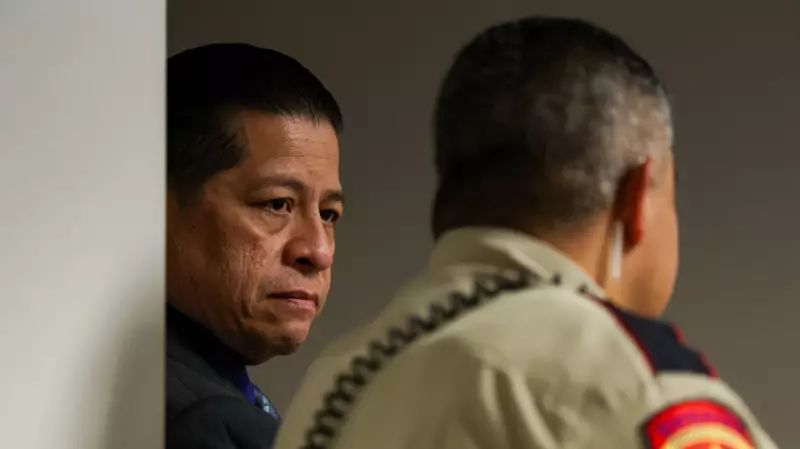
Former Uvalde school police officer Adrian Gonzales appeared to wipe away tears in court on Wednesday as a doctor read aloud the devastating injuries sustained by victims of the May 24, 2022, mass shooting at Robb Elementary School.
Emotional Testimony Details Horrific Injuries
Gonzales, who was among the first officers on the scene during one of the deadliest school shootings in American history, has been largely stoic during his trial. However, his composure broke as Dr. Cherie L. Hauptmeier, a Uvalde physician who helped care for victims that day, described the wounds. Her testimony included details of bullet fragments embedded in skin, multiple gunshot wounds, fractures, and collapsed lungs suffered by the 19 children and two teachers who were killed.
Prosecutors argue that Gonzales failed to follow his active shooter training. They contend he should have run toward the sounds of gunfire even though he could not see the shooter. In a recorded interview played in court on Tuesday, Gonzales admitted to a Texas Ranger that upon arriving at the school, he mistakenly identified the wrong person as the threat.

Teacher's Aide Recounts Chaotic Scene and Police Encounter
That person was teacher's aide Melody Flores, who testified on Wednesday. Flores described hearing a radio call about a shooter jumping a fence outside the school on May 24, 2022. She immediately went outside to usher students to safety.
"As the students were running inside, Flores said she saw the shooter. She said she thought the shooter started firing at her. That's when she fell to the ground," her testimony revealed.
After getting up, Flores saw a police car arrive. She told the officer, whom she described wearing a white short-sleeve shirt and khakis, that the shooter had entered the school from the south side and needed to be stopped. She stated the officer did not respond before she ran inside to barricade herself and students in a classroom.
"I wasn't going to let nobody hurt them," Flores said of the children. She later learned she had not been shot.
Defense attorney Nico LaHood challenged parts of Flores's testimony, suggesting "perception distortion" due to the trauma. He disputed her description of Gonzales's clothing, the shooter's entry point (surveillance showed the west side), and claimed Gonzales did speak, asking for directions to the fourth-grade building.
Lasting Trauma for Survivors and Families
The court also heard heart-wrenching accounts from parents of surviving children. Christopher Salinas, father of 10-year-old shooting survivor Samuel Salinas, said his son is triggered by popping sounds, violence on TV, slamming doors, and the color red.
Jamie Torres, mother of Khloie Torres, testified that her daughter, who was shot in the forehead and thigh while in fourth grade, now suffers from frequent headaches. Khloie was in classroom 112, where students repeatedly called 911. During one call, she pleaded, "I'm telling everyone to be quiet but nobody is listening to me... Send help."
Fourth-grade teacher Mercedes Salas, who had taught the shooter years earlier, described the lockdown terror. She told students to pray and remained poised to throw chairs if the gunman entered. One student clutched scissors for protection. "I didn't tell him to put them away because those scissors made him feel safe," Salas testified.
Through tears, she described hearing screams and gunshots from other classrooms. "When they screamed, I heard the gunshots but I didn't hear them anymore, so I knew something happened to them," she said. To comfort a student, she lied, saying the other children were screaming just because they were scared. "I had to lie to them," Salas told the court. Police eventually evacuated her classroom.