Federal Agents' Fatal Shooting of Renee Good Appears to Violate Multiple ICE Policies
Federal agents led by an Immigration and Customs Enforcement officer who surrounded and fatally shot Renee Good in Minneapolis last month appear to have violated the agency's use-of-force policies during nearly every step of the encounter, according to internal documents obtained by HuffPost. The incident, which occurred on January 7, has raised serious questions about ICE protocol and training.
ICE Handbook Outlines Clear Use-of-Force Guidelines
The ICE Firearms and Use of Force Directive serves as the authoritative guidance for all Immigration and Customs Enforcement agents. This comprehensive handbook outlines specific requirements for handling fleeing subjects, including those in vehicles, proper firearm handling in close proximity to people, deescalation guidelines, and necessary actions before resorting to deadly force. The document explicitly states that ICE employees must be familiar with its contents and comply with established policies and procedures. Violations may result in disciplinary action or other appropriate measures.
Video Evidence Reveals Multiple Policy Violations
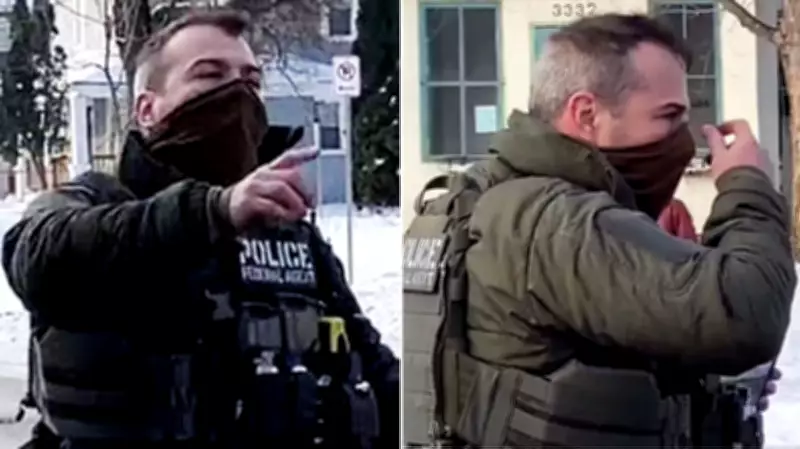
Video footage of the encounter shows three officers approaching Good's vehicle, with at least two instructing her to exit. Good remained in the driver's seat while her wife stood beside the vehicle. Federal agents used profanity-laden commands, shouting "get out of the fucking car" before one officer reached inside the driver's side window to attempt unlocking the door. ICE officer Jonathan Ross positioned himself in front of the vehicle, recording on his cellphone with one hand while holding his gun in the other.

The handbook specifically states that:
- Only one officer should give orders at a time to avoid confusion
- Officers must maintain a professional, courteous demeanor with positive attitudes
- Commands should be delivered in a professional, firm voice
- Instructions must be simple, easy to understand, and repeated as necessary
Michel Moore, former chief of the Los Angeles Police Department, explained why this early interaction created unnecessary tension. "The use of profanity in that charged situation lacks professionalism, and it heightens and escalates tensions," Moore said. "You've missed all the other steps of establishing what we call a command presence."
Tactical Errors and Questionable Decisions
Without waiting for Good to comply with orders, an officer reached inside the vehicle window. Though not explicitly prohibited, the handbook requires officers to adjust force based on evolving circumstances and consider environmental and tactical factors. Ross then fired at Good at least three times, referring to her as a "fucking bitch" after shooting her in the head.
Matthew Barge, a senior fellow for the Policing Project at NYU School of Law with 18 years of experience investigating police and public safety issues, identified multiple serious errors. "There are a number of really grave and serious tactical and legal mistakes that the officers on the scene made to ultimately precipitate a use of force that was not necessary, and not proportional to the nature of the threat," Barge stated. He noted officers approached Good in a "completely uncoordinated and really chaotic" manner.
Vehicle Approach Violates Established Training
Stepping into the path of a vehicle represents a high-risk tactic widely recognized by law enforcement as dangerous. One ICE officer previously told HuffPost they were trained to consider vehicles as deadly weapons. Following the Good shooting, officials instructed agents not to stand in front of cars and to exercise caution around them. A senior Department of Homeland Security official confirmed to NBC News that ICE officers receive training to never approach vehicles from the front, instead using a "tactical L" 90-degree angle approach to prevent injury.

Deadly Force Restrictions Clearly Defined
The ICE handbook explicitly states that deadly force is not authorized solely to prevent the escape of a fleeing suspect. Such force against a fleeing subject is only permitted when there is probable cause to believe the suspect's escape would pose imminent danger of death or serious bodily injury to officers or others. The document further warns that excessive force by ICE employees is strictly prohibited.
Moore emphasized that even with probable cause to believe Good was interfering with operations and attempting to flee, most law enforcement professionals would advise letting her leave and investigating later. "You don't shoot at a moving vehicle," he said. "You get away from it."
Use-of-Force Continuum Ignored
ICE operates under a "use of force continuum" requiring agents to weigh the totality of circumstances and first consider intermediate force options for deescalation when reasonable. Last year, the Supreme Court referenced this same "totality of the circumstances" standard when evaluating whether officers acted reasonably using deadly force.
Deescalation tactics outlined in the handbook include:
- Giving verbal warnings
- Establishing containment zones by blocking streets
- Using chemical agents as reasonable force when appropriate
Investigation Progress and Consequences
The administration has slow-walked criminal investigation of agents involved in Good's killing, despite initial slanderous characterization of her as a "domestic terrorist" by Trump officials. The FBI excluded state and local officials from the investigation, and prosecution paths for federal agents remain narrow.
While the handbook warns of consequences for policy violations, Ross appears to have faced only one outcome since the January 7 shooting. A Department of Homeland Security spokesperson confirmed last week that he had been placed on administrative leave. The Department of Homeland Security did not respond to requests for comment about apparent violations of ICE's use-of-force policy during this fatal encounter.