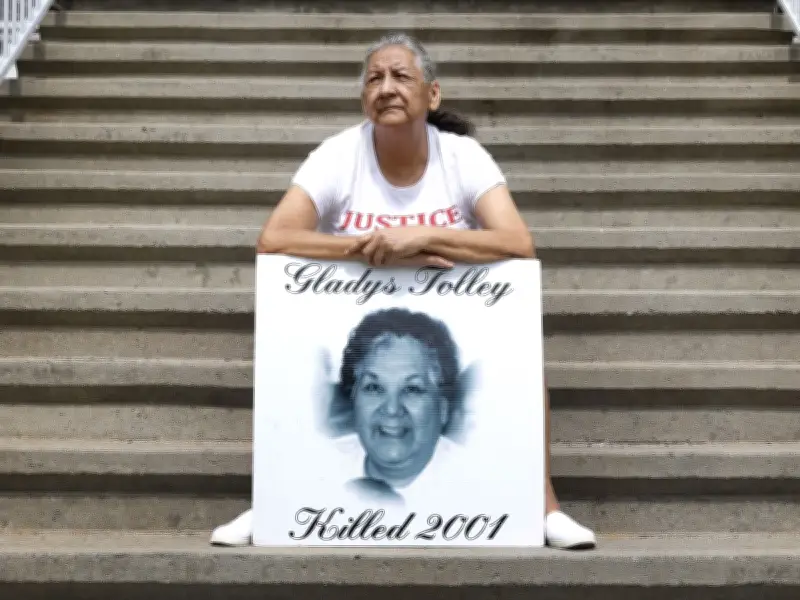
Seven years after the final report of the National Inquiry into Missing and Murdered Indigenous Women and Girls (MMIWG), advocates say the lack of action is painful. Bridget Tolley, an Indigenous advocate whose mother was killed by a police cruiser in 2001, continues to question why the system failed her family.
A Personal Tragedy
Tolley is five years older than her mother, Gladys Tolley, was when a Surete du Quebec police car struck and killed her in October 2001. She remembers rushing to see her mother at the Kitigan Zibi Anishinabeg reserve, but police turned her away.
“But the police told me to go home. Nobody was able to see my mother except the police, and the police that killed her. So, the two forces, the SQ and the native force, had taken care of everything,” Tolley says. They stayed only two hours before taking her mother to the morgue.

“Nobody really saw my mother. There was no coroner. It was very traumatizing for me when I found this all out in her report,” says Tolley, now well-known for her advocacy.
Seven Years of Inaction
June 3 marked seven years since the Congress of Aboriginal Peoples’ final report of the National Inquiry into Missing and Murdered Indigenous Women and Girls, and five years since the launch of the National Action Plan. However, progress on the 231 Calls for Justice has been uneven and far too slow, with only two completed.
“The need to renew the Calls for Justice is greater than ever because the crisis that prompted the Inquiry has not ended and meaningful implementation remains far too limited. The Calls for Justice were never meant to be a one-time commitment,” said National Chief Brendan Moore of the Congress of Aboriginal Peoples in an email.
Disproportionate Violence
According to the Assembly of First Nations (AFN), Indigenous women are four times more likely than non-Indigenous women to be victims of violence. The AFN says 16 per cent of all female homicide victims are Indigenous, and 11 per cent of missing women in Canada are Indigenous, yet Indigenous people make up only 4.3 per cent of the population.
Renewing the Calls for Justice is about ensuring that the findings of the National Inquiry do not become another report sitting on a shelf, Moore said. The release urges completion of all 231 calls and points to specific priorities for federal, provincial, and territorial governments.
Key Priorities
- Expanding access to safe, affordable, accessible and culturally relevant housing in urban, rural and remote Indigenous communities.
- Establishing a national Indigenous and human rights ombudsperson and tribunal to address complaints and monitor accountability.
Where the Calls for Justice Started
The calls for action have been ongoing much longer than the national inquiry, says Cora McGuire-Cyrette, CEO of the Ontario Native Women’s Association. The struggle for justice continues as advocates demand meaningful change.