Calgary's firefighting crew is hosting a three-day training camp for young Indigenous adults for the third consecutive year. The camp, which runs from Friday evening to Sunday, May 3, offers participants hands-on experience with firefighting equipment and real-world scenarios, such as extinguishing car fires and using hydraulic rescue tools.
Camp Details and Activities
Starting on Friday evening, 33 participants will undergo three days of exposure-based training at the Calgary Fire Training Academy and Multi-Agency Training Centre in southeast Calgary. The program is designed to give attendees a glimpse into the daily life of a firefighter, according to Curtis Gellings, recruitment officer for the city's firefighting department.
“There are not that many opportunities to apprentice or internships,” Gellings said, emphasizing the camp's role as a valuable outreach tool for the department.

The camp has more than doubled in popularity over the years, with numbers “generally pretty representative of fire interest across the industry.” Participants range in age from 18 to early 30s, and four are women.
Friday: Orientation and Gear Fitting
The camp begins with an orientation on Friday, where participants meet different teams from the department and try on bunker gear for the first time. “So that’s the first time they get to try on all of the bunker gear, which would be the pants, the jackets, helmets, face pieces,” Gellings said.
Saturday: Hands-On Training
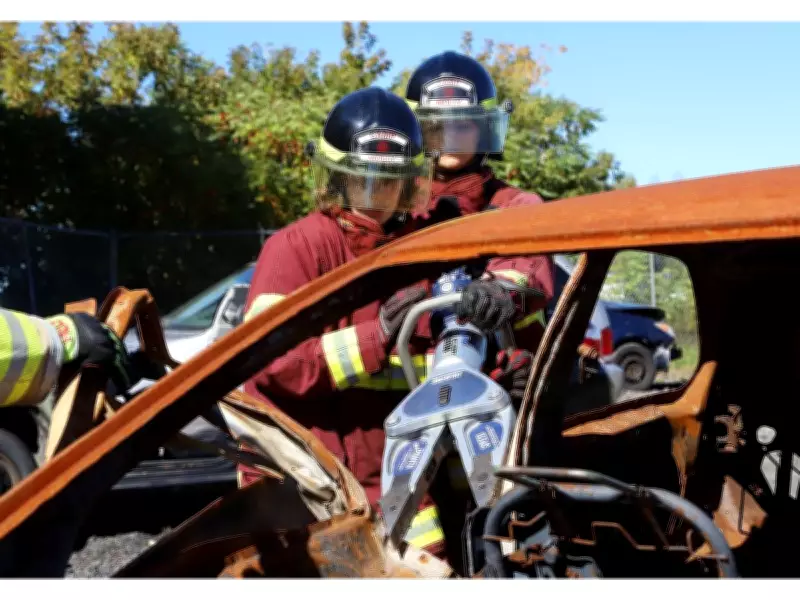
On Saturday, participants learn to use the self-contained breathing apparatus, handle hoses, and conduct search-and-rescue operations. They then move on to the “jaws of life,” a hydraulic tool used to extract accident victims from crumpled vehicles.
“The most popular are the car fire prop,” Gellings said. “Because that’s the first time they actually get to really see the fire and then utilize those skills.”
In the search-and-rescue exercise, participants experience the physical demands of firefighting by carrying mannequins of different weights and sizes while wearing rescue gear.
“A lot of people are very surprised by what it’s like to actually have the (apparatus) on and be breathing through a cylinder, and then just the amount of work that it takes to actually search a home,” Gellings said. “Because they were never aware of how much physical exertion goes into it.”
Community Connection and Mentorship
The camp is a two-way street. It offers young men and women a chance to learn about the profession and provides firefighters an opportunity to connect and mentor within the Indigenous community.
“Historically, we may not have had as strong of relationships with the urban Indigenous people who live in Calgary as well as the surrounding communities that support Calgary. Us providing this camp is an opportunity for not only us to provide opportunity, but for us to learn as well,” Gellings said.