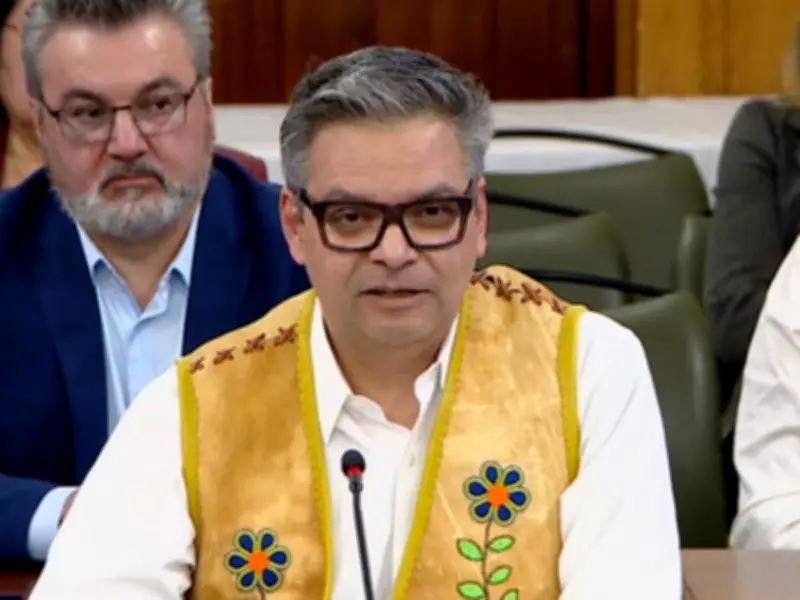
Cree Grand Chief Paul John Murdoch delivered a powerful critique of the Coalition Avenir Québec's proposed constitution during a National Assembly committee hearing on Thursday, warning that the legislation threatens to unravel decades of hard-won progress in Indigenous-provincial relations.
A Step Backward for Indigenous Rights
Murdoch, a lawyer and grandson of former Cree chief Malcolm Diamond, testified that Bill 1 represents a significant regression from the collaborative framework established over the past 55 years. "It's difficult not to see Bill 1 as a step backward — a serious and significant setback from everything we've built over the last 55 years," Murdoch stated, emphasizing that the Cree Nation was not consulted during the drafting process.
The Grand Chief drew parallels between the current proposal and the contentious history surrounding the James Bay megaproject, recalling how his grandfather and uncle, the late Grand Chief Billy Diamond, were dismissed by then-Premier Robert Bourassa in 1971. That encounter helped trigger years of conflict before the landmark James Bay and Northern Quebec Agreement was signed in 1975.

Constitutional Concerns and Colonial Echoes
Murdoch argued that Justice Minister Simon Jolin-Barrette's proposal reduces Indigenous rights to vague language in the bill's preamble rather than providing meaningful protections within the text itself. "Even the words added to the preamble are a rollback compared to what we've seen in past laws," he noted.
The Cree leader's testimony followed a tense exchange between Francis Verreault-Paul, chief of the Assembly of First Nations Quebec-Labrador, and Jolin-Barrette the previous week. Verreault-Paul had denounced the proposed constitution as colonialist and assimilationist, sentiments echoed by Murdoch in his presentation.
Specific Objections to the Proposal
Murdoch outlined several fundamental problems with the constitutional draft:
- Unilateral Power Assumptions: The proposal presumes Quebec government authority to override Cree laws, contradicting guarantees of Cree legal primacy established in previous agreements.
- Interference in Federal Relations: The constitution attempts to interfere with the Cree Nation's relationship with the federal government, despite agreements requiring tripartite cooperation.
- Exclusionary Process: The document was developed without Indigenous consultation, creating division rather than unity.
"If a Cree community passes a law — for example, to allow prayers in public spaces — the Quebec government does not have the power to override that, contrary to what this constitution is presuming," Murdoch explained.
A Call for Collaborative Constitution Building
Murdoch contrasted the current approach with the positive relationships the Cree Nation developed with former premiers René Lévesque, Bernard Landry, and Lucien Bouchard. "For them, it was never necessary to put one people down to elevate another," he recalled. "The moment we help our neighbour, we help ourselves."
The Grand Chief called for a complete restart of the constitutional process, emphasizing that "everyone should be invited, and they should know that this is an exercise not meant to put anyone down." He suggested that a constitution should serve as "a foundation that brings people together" rather than creating division and polarization.
Government Response and Ongoing Debate
Justice Minister Jolin-Barrette responded to Murdoch's criticisms by stating, "We disagree on what the text says. I take note of your comments and suggestions, and I will also be interested, throughout the detailed study, in receiving and discussing with you how the text could be improved to your satisfaction in particular."
Murdoch remained firm in his position, concluding his testimony with a direct challenge: "The day you are ready to receive our comments at the beginning — so the foundation of the document brings people together instead of creating division — we will be there. We respect our word. We ask the government to do the same."

The proposed constitution, which aims to become Quebec's "law of laws" by defining the Quebec nation and its founding principles, faces opposition from all political parties in the National Assembly as well as Indigenous leaders who view it as a threat to hard-won rights and relationships.