

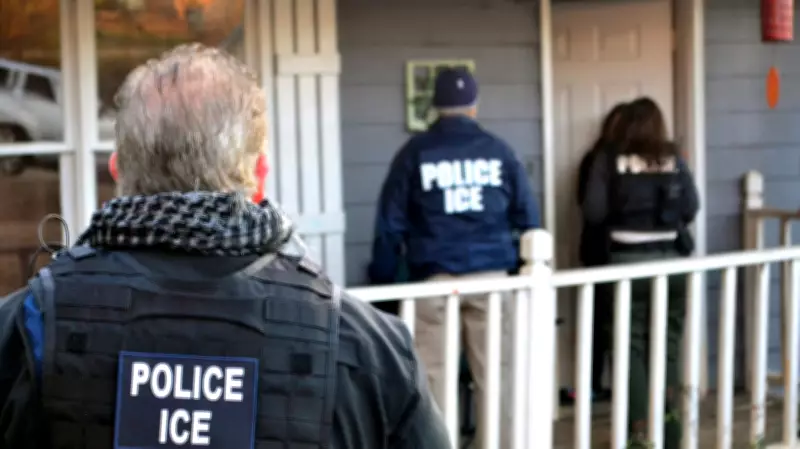
Florida Wildlife Officers Conduct Immigration Checks Under Expanded Federal Program
In a significant expansion of immigration enforcement powers, officers from Florida's Fish and Wildlife Conservation Commission have been conducting immigration checks during routine fishing inspections, according to recently released body camera footage. The incident occurred last August when officers approached a group of Hispanic men fishing on a dock and subsequently called Immigration and Customs Enforcement (ICE) to detain five individuals.
Expanded Authority Under 287(g) Agreements
The wildlife officers were operating under Florida's expanded 287(g) agreement with the federal government, a program that allows state and local law enforcement agencies to perform duties typically reserved for federal immigration authorities. This expansion occurred months earlier as part of a broader trend among Republican-led states to increase cooperation with federal deportation efforts since Donald Trump returned to the White House.
"We've been instructed to check with immigration on anyone that just gives us a passport and doesn't appear to be a citizen," one officer stated in the footage, though it remains unclear who issued these instructions. Thomas Kennedy, a policy analyst with the Florida Immigrant Coalition, described the situation as police being deputized into a "show me your papers patrol."

National Expansion of Immigration Enforcement
The 287(g) program has seen exponential growth under the current administration, with 1,313 law enforcement agencies across the country now participating in these agreements, up from just 135 in September 2024. According to the Migration Policy Institute, Florida alone received $39 million in federal funding last year to support these operations.
Cori Alonso-Yoder, a law professor and director of the Immigration Clinic at the University of Maryland, noted that "the current enforcement model is the on-the-street, mass roundup style." Thirty-nine states now have at least one 287(g) agreement in place, while seven states have regulations prohibiting such agreements.
Training Concerns and Legal Challenges
Serious concerns have emerged about the training provided to officers undertaking immigration enforcement duties. The Florida wildlife officer involved in the August incident joked about receiving minimal training, describing himself and colleagues as "looking like a newborn giraffe with wobbly legs" and noting they had received only about one hour of online instruction.
These training deficiencies have led to legal challenges. In West Virginia, which entered a 287(g) agreement in August 2025, a federal judge recently ordered the release of two immigrants from Venezuela and Honduras who had been wrongly jailed. The judge stated there was "not a shred of evidence" to support their detention, highlighting potential civil rights violations.
State Legislation and Community Impact
Florida has paired its 287(g) expansion with additional legislation requiring state agencies to use their "best efforts" to support federal immigration enforcement. Other Republican-led states are following similar paths, with Tennessee enacting eight immigration-related laws in just ten months, including measures that hold charities liable for housing undocumented immigrants and invalidate certain out-of-state driver's licenses.
Lisa Sherman Luna, executive director of the Tennessee Immigrant and Refugee Rights Coalition, explained that "Tennessee has long been a testing ground for an anti-immigrant agenda," noting collaboration with former White House advisor Stephen Miller to create a model for immigration enforcement.
Chilling Effects on Immigrant Communities
The expanded enforcement has created widespread fear within immigrant communities. During a debilitating ice storm in Nashville that left residents without power or water for over a week, some immigrants were afraid to access emergency shelters. "Our communities are terrified," Sherman Luna reported. "You have a portion of the population that doesn't feel safe enough to access those shelters."

Despite public opinion shifting against harsh immigration policies—with 60% of voters in a February Quinnipiac University poll believing the federal government was being too harsh—the 287(g) program continues to expand. Experts suggest this bureaucratic approach to enforcement may help soften public criticism compared to more visible, militarized operations.
Alonso-Yoder observed that "what 287(g) does is take the enforcement back behind closed doors," creating a system where immigration checks become routine interactions rather than dramatic public displays of force. This shift comes as the Trump administration seeks to avoid the public backlash that followed highly visible enforcement actions in cities like Minneapolis.





