

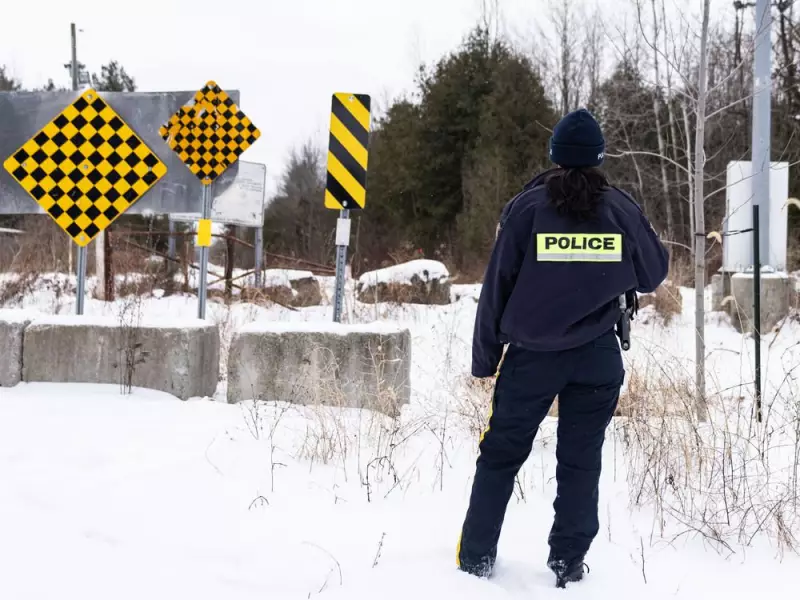
The surge of asylum seekers crossing into Canada from upstate New York has dramatically slowed, marking a significant reversal from the high volumes seen earlier in the year. New data reveals a sharp decline in arrivals at Quebec's busiest irregular land crossing, coinciding with a stricter application of border rules that sees more people quickly returned to the United States.
A Notable Decline in November Arrivals
According to government figures obtained by Bloomberg News, only 518 people requested asylum at the Saint-Bernard-de-Lacolle, Quebec crossing in November 2025. This represents a notable decrease, not only from the peak summer months but also from the same period last year, when 637 claims were made. This year-over-year drop is the first recorded since February, signaling a potential shift in migration patterns.
The contrast with earlier in the year is even more striking. From March through August 2025, the site saw an average of over 1,900 asylum claims per month—a massive 184 per cent increase compared to the previous year. The current ebb in the flow suggests that changing enforcement practices are having a tangible impact.

Stricter Enforcement and Increased Removals
Legal experts and refugee advocates point to a significant change in how border officials are applying existing regulations. While the rules themselves may not have changed on paper, their enforcement has become more rigorous. This increases the risk for individuals arriving at the border, as those deemed ineligible can be turned back to the U.S. rapidly, where they may face detention by U.S. Immigration and Customs Enforcement (ICE).
"The rules may not have changed on paper, but how they’re enforced has," observed Audrey Macklin, a human-rights law professor at the University of Toronto and former member of Canada’s Immigration and Refugee Board.
The statistics from the Canada Border Services Agency (CBSA) support this observation. In the first eleven months of 2025, Canada sent 4,035 refugee claimants back to the U.S. for being ineligible under the Safe Third Country Agreement (STCA). This figure is 29 per cent higher than during the same period in 2024. Approximately two-thirds of those returned had initially arrived at an official port of entry.
Policy Context and the Roxham Road Legacy
The region of southern Quebec, particularly around the unofficial crossing point often referred to as Roxham Road, has been a focal point for Canada's asylum system for years. Migrants have long used a loophole in the Safe Third Country Agreement—a pact between Canada and the U.S. designed to manage refugee claims—by crossing on foot between ports of entry. This pathway saw increased use following the inauguration of former U.S. President Donald Trump.
Montreal has been a particularly appealing destination, especially for Haitian refugees, due to its French-speaking majority and established Haitian diaspora. In 2023, the STCA was tightened with measures explicitly aimed at discouraging these irregular crossings by making it more difficult for claimants to remain in Canada.
The current decline in crossings occurs as Prime Minister Mark Carney continues policies initiated late in Justin Trudeau's administration to tighten requirements for both permanent residents and temporary immigrants. Carney has stated that the immigration system must be brought "under control," fueling an ongoing national debate about the balance between humanitarian obligations and border management.
The dramatic reduction in asylum seekers at the Quebec-New York border underscores the direct effects of policy enforcement shifts. As Canada maintains its firmer stance, the data from Saint-Bernard-de-Lacolle serves as a key indicator of how border dynamics are evolving, with significant implications for migrants, policymakers, and the communities that receive them.






