

Nationwide Demonstrations Challenge Immigration Enforcement Tactics
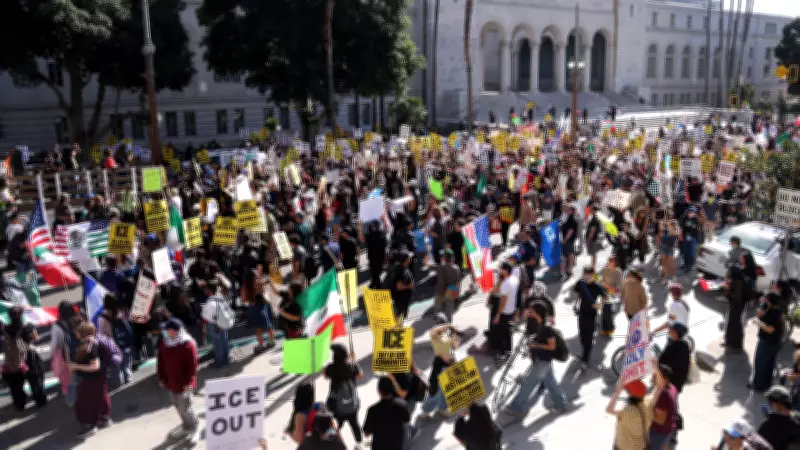
Across the United States, a coordinated wave of protests unfolded on Friday, January 30, 2026, under the banner of "no work, no school, no shopping" strikes. These widespread demonstrations represented a direct challenge to the Trump administration's intensified immigration enforcement operations. The actions were fueled by mounting public outrage over recent incidents involving federal immigration officers, which have sparked intense scrutiny of their methods and authority.
Minneapolis Becomes Epicenter of Protest Movement
The city of Minneapolis emerged as a focal point for the protest movement, with hundreds gathering in frigid conditions outside the Bishop Henry Whipple Federal Building. This location has become a regular site for demonstrations in recent weeks, reflecting the community's deep engagement with the issue. After speeches from local clergy members, protesters marched toward restricted areas of the federal facility, confronting Department of Homeland Security agents with chants demanding they "quit your jobs" and "get out of Minnesota." The gathering eventually dispersed after local law enforcement threatened arrests for road blockages.
Michelle Pasko, a retired communications worker from the Minneapolis suburb of Minnetonka, explained her participation in the protest. "They're roaming our streets, they're staying in hotels near our schools," she stated, describing federal immigration agents operating in her community. "Everyone in this country has rights, and the federal government seems to have forgotten that. We're here to remind them." Her comments highlight the personal impact these enforcement operations have had on ordinary citizens.

Student Walkouts and Business Closures Show Widespread Support
The protest movement gained significant momentum through organized student walkouts and business participation. In Birmingham, Michigan, dozens of students from Groves High School braved zero-degree temperatures to walk approximately one mile to their local business district. Their demonstration drew supportive honks from morning commuters, illustrating community solidarity with their cause.
Logan Albritton, a 17-year-old senior at Groves High School, articulated the students' motivation: "We're here to protest ICE and what they're doing all over the country, especially in Minnesota. It's not right to treat our neighbors and our fellow Americans this way." Similar actions occurred in Georgia, where 16-year-old Abigail Daugherty organized a walkout at Collins Hill High School in Suwanee, stating, "For years, I have felt powerless, and seeing other schools in the county being able to do this, I wanted to do something."
Businesses across the nation responded to the call for a "blackout" day with varied approaches. Some establishments closed entirely, while others remained open but pledged to donate portions of their proceeds to immigrant support organizations. In New York, Otway Restaurant and its sister Otway Bakery announced they would stay open despite recent financial challenges from winter storm closures, committing 50% of their Friday proceeds to the New York Immigration Coalition.
National Scope of Demonstrations Reveals Broad Opposition
Protests extended far beyond the Midwest, with significant gatherings reported in multiple major cities. In Los Angeles, thousands of demonstrators assembled in front of city hall before marching to a federal detention center. The protest escalated as federal agents deployed chemical sprays to disperse the crowd in the evening hours. Democratic Representative Maxine Waters joined the Los Angeles demonstration, chanting "ICE out of LA" alongside protesters facing officers in riot gear.
In San Francisco, California, thousands of students, workers, and activists gathered at Dolores Park before marching to City Hall to show solidarity with Minneapolis. Chicago witnessed protesters assembling at Federal Plaza as part of the coordinated "Nationwide Shutdown" and general strike. These simultaneous actions across multiple states demonstrated the breadth of opposition to current immigration enforcement practices.

Controversial Incidents Fuel Protest Momentum
The protest movement gained urgency following several high-profile incidents involving immigration enforcement officers. The killing of Alex Pretti, an intensive care nurse shot multiple times after recording Border Patrol officers conducting an operation in Minneapolis, generated widespread outrage. This tragedy followed the January 7 death of Renee Good, who was fatally shot by a U.S. Immigration and Customs Enforcement officer while behind the wheel of her vehicle. These incidents have intensified scrutiny of federal immigration enforcement tactics and contributed to the growing protest movement.
In a concerning development in Nebraska, a student was struck by an SUV displaying a Trump flag during a protest outside Fremont High School on Thursday. According to school officials, the incident occurred when a few students entered the street and one was hit by a vehicle that had stopped before accelerating. The student was transported to a hospital, though details about the extent of injuries were not immediately released.
Educational Institutions Grapple with Immigration Enforcement Impact
The protest movement highlighted the significant impact immigration enforcement has had on educational environments. Some schools in Arizona, Colorado, and other states preemptively canceled classes in anticipation of mass absences related to the protests. Grace Valenzuela, an administrator with Portland Public Schools in Maine, spoke passionately about how ICE operations affect learning environments.
"Schools are meant to be places of learning, safety and belonging. ICE undermines that mission every time it destabilizes a family," Valenzuela stated, describing an "enforcement system that treats our presence as suspect" and brings "daily trauma" to the school system. Her comments were made during a gathering outside a Portland church where protesters held signs reading "No ICE for ME," referencing Maine's postal code abbreviation.
Political Responses Reflect Deep Divisions
The protests elicited varied responses from political figures across the nation. In Maine, where Republican Senator Susan Collins announced that ICE was ending its enforcement surge in the state, Portland Mayor Mark Dion emphasized the importance of dissent in democratic systems. "Dissent is Democratic. Dissent is American. It's the cornerstone of our democracy," the Democratic mayor stated during the Portland gathering.
Meanwhile, protest organizers utilized digital platforms to coordinate nationwide actions, with one website proclaiming, "The people of the Twin Cities have shown the way for the whole country — to stop ICE's reign of terror, we need to SHUT IT DOWN." This digital coordination enabled simultaneous demonstrations in communities across the United States, from city centers and statehouses to churches and business districts.
The nationwide protests represent a significant moment in the ongoing debate over immigration enforcement in the United States, demonstrating substantial public opposition to current policies and tactics while highlighting the personal and community impacts of these enforcement operations.





