

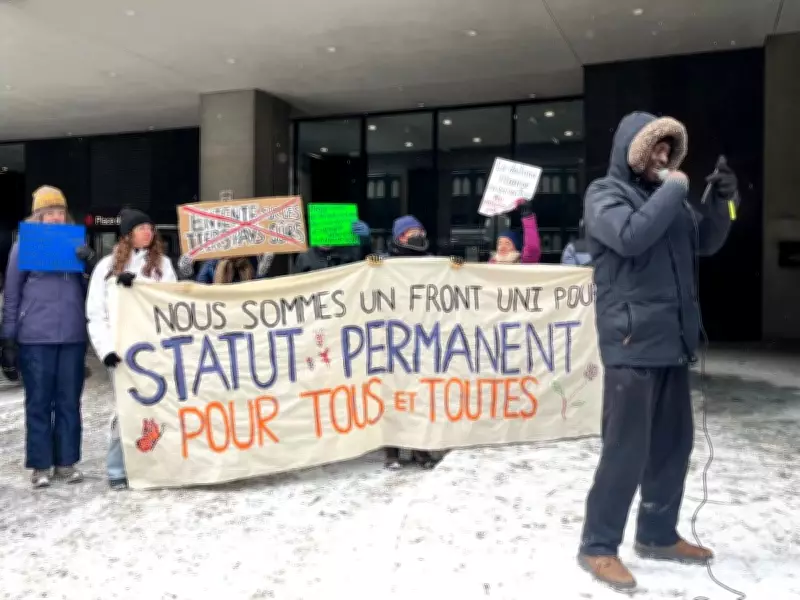
Montreal Protest Demands Immigration Reform and Pathway to Permanent Status
Dozens of demonstrators gathered in downtown Montreal on Saturday, February 7, 2026, to call for significant changes to Canada's immigration policies. The rally, organized by Solidarity Across Borders, took place outside federal immigration offices on St-Antoine St. W., near the Canada Border Services Agency and Immigration, Refugees and Citizenship Canada buildings.
Core Demands of the Protest Movement
The protest centered on two primary demands: establishing a clear pathway to permanent residence for individuals with precarious or no immigration status, and terminating the Safe Third Country Agreement (STCA) between Canada and the United States. Protest organizers argued that current policies are creating a growing population of undocumented residents who face increasing vulnerability.
Aboubacar Kane, a spokesperson for Solidarity Across Borders, emphasized that Canada must reexamine its migration policies as global attention focuses on immigration enforcement practices in neighboring countries. "Measures adopted by both Quebec and federal governments are increasing precarity among migrant communities," Kane stated, adding that these policies contribute directly to rising numbers of undocumented residents.

The Safe Third Country Agreement Controversy
The Safe Third Country Agreement, which requires asylum seekers to request protection in the first safe country they enter, has become a focal point of criticism. Under this agreement, asylum seekers who arrive in the United States before reaching Canada are typically turned back at the border. While exceptions exist—such as for individuals married to Canadian citizens—immigration lawyers report that even these pathways have become increasingly difficult to navigate successfully.
Kane specifically criticized proposed federal legislation currently before the Senate, arguing that "the United States cannot be considered a safe country for all migrants." This perspective challenges the fundamental premise of the bilateral agreement between the two nations.
Statistical Evidence of Growing Crisis
Organizers presented compelling statistics to support their calls for policy reform. According to federal figures cited during the demonstration, Canada deported 22,100 people in 2025 alone, not including individuals who left voluntarily after being unable to renew their temporary status. Additionally, 32,800 refused refugee claimants remain in Canada, significantly swelling the population of people without legal status.
Another spokesperson identified only as Farid urged Canadian authorities to follow international examples, specifically pointing to Spain's implementation of a large-scale regularization program for undocumented migrants. "The federal government promised a regularization program in December 2023," Farid noted, "but later abandoned it amid rising anti-migrant sentiment."
Worker Protection and Permanent Status
Susana Ponte Rivera, an organizer with the Immigrant Workers Centre's women's committee, highlighted the connection between immigration status and workplace protections. "An inclusive regularization program and permanent residence are the only way to protect workers without status from harassment and violence at work," she asserted. "This approach ensures their rights are respected in a lasting and meaningful way."
Rivera emphasized that permanent status represents more than just legal documentation—it provides essential safeguards against exploitation in employment situations where migrant workers may otherwise remain vulnerable.
Broader Implications for Canadian Immigration Policy
The Montreal protest reflects growing concerns about Canada's approach to migration management and humanitarian obligations. As global migration patterns continue to evolve, advocacy groups are pressing for policies that prioritize regularization and integration over enforcement and exclusion.

The demonstration's location outside federal immigration offices symbolized direct engagement with the institutions responsible for implementing the policies being challenged. Participants called for a fundamental shift toward more inclusive approaches that recognize the contributions of migrants while addressing systemic vulnerabilities created by current legal frameworks.





