

Minnesota Mother's Dramatic Arrest Under Federal Law Sparks Debate Over ICE Observers
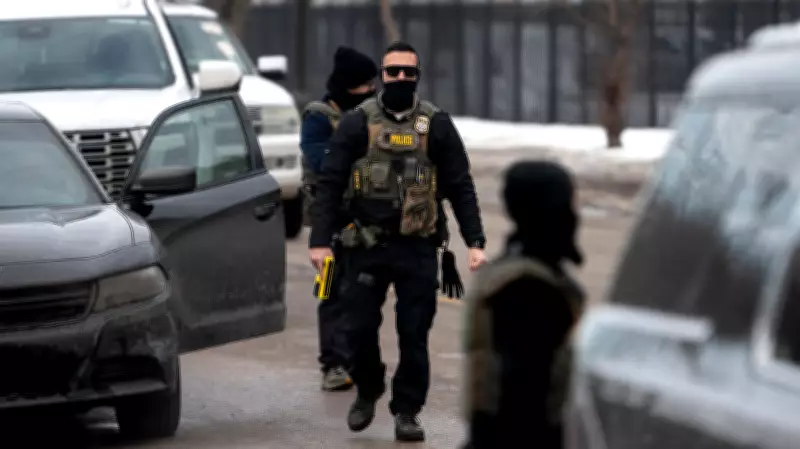
In a startling incident in suburban Minneapolis, Becky Ringstrom, a 42-year-old mother of seven, found herself surrounded by unmarked vehicles and arrested by masked federal agents while driving home. The confrontation, captured on bystander video and verified by Reuters, occurred after Ringstrom had been following Immigration and Customs Enforcement (ICE) officers in her gray Kia SUV. Agents approached her vehicle, with one knocking on her windshield with a metal object, before taking her into custody.
Federal Charge Used in Thousands of Cases
Ringstrom was transported to the Bishop Henry Whipple Federal Building in Minneapolis, where she received a citation under Title 18, Section 111 of the U.S. Code. This federal statute criminalizes forcibly assaulting, resisting, opposing, impeding, intimidating, or interfering with a federal officer performing official duties. The charge can be filed as either a felony or misdemeanor, with felony convictions carrying potential sentences of up to twenty years in prison, though penalties exceeding eight years typically require the use of a dangerous weapon or resulting injury.
A comprehensive Reuters review of federal court records reveals that the Trump administration has prosecuted at least 655 individuals under this charge across the United States since last summer's city-focused immigration crackdowns began. This figure represents more than double the prosecutions during the comparable period in 2024-2025, according to an analysis of publicly available criminal filings in the Westlaw legal research database.

Expanding Database of Protesters
U.S. Department of Homeland Security spokesperson Tricia McLaughlin defended the actions, stating that "assaulting and obstructing law enforcement is a felony" and that officers "used the minimum amount of force necessary to protect themselves, the public, and federal property." Meanwhile, ICE has been systematically tracking protesters' names in an internal database for several months, according to two anonymous agency officials. This database reportedly contains names, photographs, suspicious actions, locations, and license plate information, with the stated purpose of identifying patterns that could lead to criminal charges.
White House spokeswoman Abigail Jackson emphasized the administration's commitment to protecting First Amendment freedoms while asserting that those impeding law enforcement "will be held accountable to the fullest extent of the law." One official indicated that ICE was referring several people per day in Minnesota alone to federal prosecutors for potential charges under the same statute.
Legal Experts Question Application of Statute
Ringstrom described watching ICE officers for approximately forty-five minutes as they sat in a parked car in her neighborhood on January 29. When the officers began to move, she decided to follow at a distance of multiple car lengths. At a roundabout, a Border Patrol agent approached her vehicle and issued a warning, according to video Ringstrom recorded on her phone. Minutes later, as she started heading home, multiple federal vehicles stopped and arrested her.
"I know what I'm doing is not wrong," Ringstrom told Reuters in an interview, though she admitted feeling terrified during the arrest, particularly fearing she might suffer the same fate as Renee Good, one of two U.S. citizen protesters fatally shot by federal immigration officers in Minneapolis in January.
Seth Stoughton, a policing-focused professor at the University of South Carolina School of Law, expressed skepticism about applying the statute to Ringstrom's actions. "Without any physical contact, just following an agent in a car, it's not clear to me that that's resistance or impeding in the first place, and it certainly seems like a stretch to establish that as forcible," Stoughton explained, noting that the law specifically requires the alleged crime to be committed "forcibly."

Escalating Confrontations and Intimidation Tactics
Recent weeks have witnessed multiple incidents where ICE officers drew weapons while approaching vehicles allegedly following them. On January 29, south of Minneapolis, federal immigration officers abruptly swerved, stopped their vehicle, and approached a woman driving behind them with guns drawn, according to verified dashcam footage. McLaughlin stated that officers were attempting to arrest a criminal offender when the woman began "stalking and obstructing" them.
In a separate February 3 incident, two ICE officers approached another car with guns drawn after alleging the vehicle had been "stalking" and "obstructing" them. The Department of Homeland Security claimed the occupants made hand motions suggestive of possessing a firearm, though Reuters could not independently verify this account.
Some Minnesota residents believe they are facing an intimidation campaign. In a suburb north of St. Paul on January 22, an ICE officer led a woman who had been following his vehicle back to her house, demonstrating knowledge of her identity and address. When the woman's husband questioned this tactic, the officer reportedly responded, "You raise your voice, I erase your voice." One ICE officer anonymously told Reuters they have employed this license plate tracking tactic specifically "to freak them out."
Broader Pattern of Enforcement Actions
Earlier in January, two friends following an ICE vehicle in Minneapolis reported that officers fired pepper spray into their car, smashed their window, and detained them for eight hours. McLaughlin stated that officers gave multiple warnings "to stop impeding" operations before making the arrest, though she did not explicitly confirm the window breaking or pepper spray deployment. The individuals have not been charged.
Deborah Fleischaker, a former top ICE official under President Joe Biden, criticized the current approach as "inappropriate and unconstitutional," arguing that "observing ICE activities is not a crime and should not be treated as such." A federal judge in Minneapolis issued a mid-January order stating that a vehicle following ICE at "an appropriate distance" did not justify a traffic stop or arrest, though this order was paused by an appeals court ten days later.
The Trump administration's increased use of Title 18, Section 111 prosecutions represents a significant escalation in efforts to deter opposition to immigration enforcement operations, raising fundamental questions about the balance between law enforcement authority and citizens' rights to observe government activities.





