ICE Directive Permits Forced Home Entry Without Judicial Warrants, Marking Sharp Policy Shift
Federal immigration officers are now authorized to forcibly enter private residences without judicial warrants, according to an internal Immigration and Customs Enforcement memo obtained by The Associated Press. This sweeping policy change represents a dramatic reversal of longstanding guidance that respected constitutional limits on government searches and has sparked immediate concerns about Fourth Amendment violations.
New Policy Authorizes Force Based on Administrative Warrants
The memo, signed by acting ICE director Todd Lyons and dated May 12, 2025, explicitly authorizes ICE officers to use force to enter homes based solely on administrative warrants to arrest individuals with final removal orders. This approach directly contradicts years of advice given to immigrant communities and legal guidance rooted in Supreme Court rulings that generally prohibit law enforcement from entering homes without judicial approval.
The document states: "Although the U.S. Department of Homeland Security has not historically relied on administrative warrants alone to arrest aliens subject to final orders of removal in their place of residence, the DHS Office of the General Counsel has recently determined that the U.S. Constitution, the Immigration and Nationality Act, and the immigration regulations do not prohibit relying on administrative warrants for this purpose."

Implementation Amid Expanded Deployment
This policy shift comes as the Trump administration dramatically expands immigration arrests nationwide, deploying thousands of officers under a mass deportation campaign that is already reshaping enforcement tactics in cities across the country. The memo has been used to train new ICE officers being deployed to implement the president's immigration crackdown, despite conflicting with written training materials.
According to a whistleblower complaint, newly hired ICE officers are being instructed to follow the memo's guidance rather than contradictory written training materials. The memo has not been widely shared within the agency but has been shown selectively to officials who were told to read it and return it without taking notes.
Real-World Application in Minneapolis
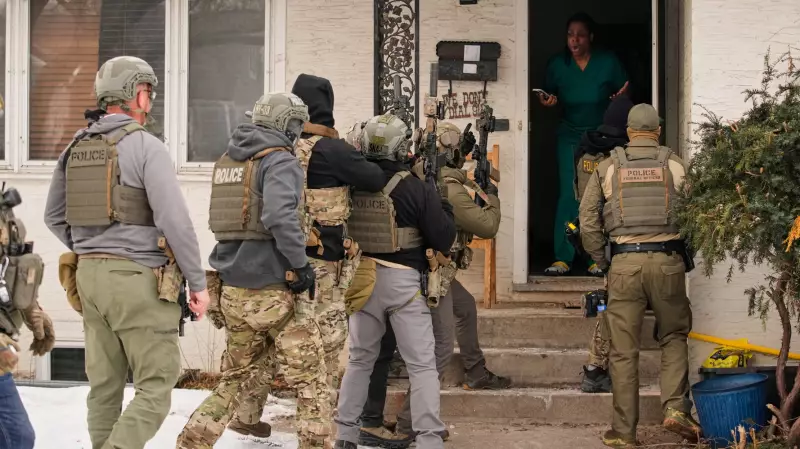
The Associated Press witnessed the practical application of this policy on January 11, 2026, when ICE officers rammed through the front door of a Liberian man's home in Minneapolis using only an administrative warrant. Officers wore heavy tactical gear and had their rifles drawn during the operation. Documents reviewed by AP confirmed that agents only possessed administrative warrants, meaning no judge had authorized the raid on private property.
This incident illustrates how the policy is being implemented despite traditional understanding that administrative warrants authorize arrests but do not permit forced entry into private homes without consent. Only judicial warrants signed by judges carry that authority under normal constitutional interpretation.
Constitutional Concerns and Legal Challenges
Immigrant advocates, legal aid groups, and constitutional experts have raised serious concerns about the policy's compatibility with Fourth Amendment protections against unreasonable searches and seizures. The Fourth Amendment protects all people in the country, regardless of immigration status, and generally requires judicial warrants for home entries except in specific emergency circumstances.
David Kligerman, senior vice president and special counsel at Whistleblower Aid, which represents two anonymous government officials disclosing the policy, called it a "complete break from the law" that undercuts "the Fourth Amendment and the rights it protects." The organization's whistleblower complaint describes the directive as "secretive - and seemingly unconstitutional."

Administration Defense and Procedural Requirements
When questioned about the memo, Homeland Security spokeswoman Tricia McLaughlin defended the policy in an emailed statement, asserting that everyone served with administrative warrants has already had "full due process and a final order of removal." She stated that officers issuing these warrants have found probable cause for arrest and that both the Supreme Court and Congress have "recognized the propriety of administrative warrants in cases of immigration enforcement."
The memo does outline some procedural requirements for officers:
- Officers must first knock on the door and identify themselves and their purpose
- Entries are limited to hours between 6 a.m. and 10 p.m.
- People inside must be given a "reasonable chance to act lawfully"
- Force should be used only when necessary and reasonable after proper notification
Broader Enforcement Context
This policy change occurs within a broader context of expanded immigration enforcement that has seen a wave of high-profile arrests at private homes and businesses. Most immigration arrests traditionally occur under administrative warrants, but officers typically wait for individuals to appear in public spaces to avoid constitutional complications.
The memo specifically authorizes forced entry using I-205 administrative warrants for individuals with final removal orders issued by immigration judges, the Board of Immigration Appeals, or federal judges. This represents a significant expansion of enforcement authority that is almost certain to face legal challenges from advocacy groups and immigrant-friendly state and local governments that have spent years advising communities about their constitutional rights.
The policy's full implementation remains unclear, as does how frequently ICE officers have entered homes relying solely on administrative warrants since the memo's issuance. What is clear is that this directive marks a substantial shift in immigration enforcement tactics with profound implications for constitutional protections and immigrant communities nationwide.