

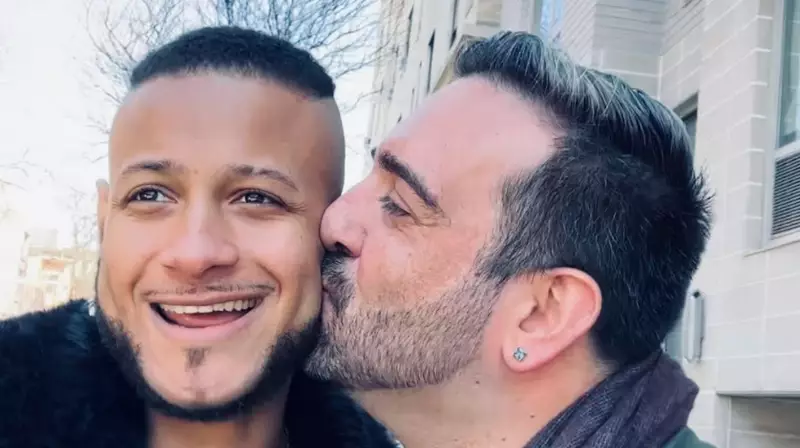
The day Matthew Collin Marrero married Allan Michael Dabrio Marrero was cool, quiet, and sacred. Matthew wore indigo-purple, his favourite colour. Allan looked dapper in cobalt blue. Their best friend, acting as witness at Brooklyn City Hall, completed the moment with a perfect shade of green. As their names were called, Matthew's heart raced. He was dizzy with love, thinking of the incredible odds of finding his true partner. They exchanged rings and vows with tears in their eyes. Pronounced husband and husband, they sealed it with a kiss, their friend's joyful squeal echoing in the chapel—a sound that still makes them laugh.
From a Perfect Wedding to a Government Building
After photos, a song began to play in the hallway. Allan took Matthew's hand and danced. He whispered it was a sign; the song was his grandmother's favourite. They cried, held each other, and danced. It was perfect. The next time they entered a government building together, more than two years later on November 24, 2025, everything unravelled.
They arrived at 26 Federal Plaza in New York for Allan's long-awaited green card interview. It was nearly a year into Donald Trump's presidency, and the climate around immigration was terrifying. Nervous but confident, they were accompanied by their pastor from Middle Church. They carried a meticulously organized, three-inch-thick binder containing every immigration document Allan had amassed since arriving from the Cayman Islands in 2013, plus hundreds of photos and letters affirming their marriage.

This time, their colours were muted: chocolate brown and charcoal. A woman at check-in smiled and blessed them. The waiting room was cold. When their number was called, they approached—only to be stopped. The officer asked for their documents. They proudly presented their binder.
She scoffed and refused to accept it.
They were instructed to dismantle weeks of careful organization and hand over loose papers. Something felt wrong immediately. After a 45-minute wait, the officer returned. When they introduced their pastor, the officer refused to allow her into the interview, a discretion not applied to other families. A supervisor confirmed the officer's right to refuse—the same officer who disliked their binder.
An Interrogation and a Devastating Ambush
Inside the office, they were instructed not to sit together. Allan sat before the desk; Matthew was placed against the wall. The questioning began. When Matthew glanced at Allan while answering how they met, the officer snapped her fingers and scolded him. When he spoke of seeing no flaws in his husband, she retorted sharply, “No one is perfect.” It felt like a criminal interrogation.
Then came the ambush. They were informed of an unresolved issue from 2022 that Allan had never been told about: he allegedly missed a court hearing notice and was ordered removed in absentia without his knowledge. The officer stated that because of this, even though their marriage was bona fide, his green card could not be approved. Allan, meticulous with paperwork since 2013, was devastated.
Initially assured they could leave safely, the officer's tone changed. She admitted she could only control her office and couldn't guarantee their safe departure. When Matthew asked directly if Allan would be detained, she said she didn't know.
Moments later, they were led through a maze of hallways. Allan was handed over to ICE. They took him with barely a moment for goodbye. He was moved to a floor and made to sit under a foil blanket. Matthew ran back to their pastor, saying, “They took him.” Their church community rallied, securing legal counsel through Make the Road New York.
A Harrowing Journey Through Detention
Allan did not call as promised. The next morning, Matthew, his mother, and their pastor returned to Federal Plaza to demand Allan receive his prescription medications, only to learn he had been transferred without notice to a New Jersey detention facility.
Matthew finally spoke to Allan more than 24 hours later in a three-minute call. Allan said they had taken his suit, phone, and wedding ring. The symbol of their commitment was replaced by shackles on his wrists and ankles. He was transported like cargo.

Inside, conditions were indistinguishable from prison. Visitation occurred in a deafening cafeteria-like room where guards yelled at Matthew for holding his husband's hand. Allan has been transferred four times across the country—to Arizona, Texas, the infamous “Alligator Alcatraz” with overflowing toilets, and now Mississippi—constantly shackled, bruised, and traumatized.
Their legal team filed a motion to reopen his case, halting deportation. The motion was accepted, and they now await a bond hearing, hoping for Allan's release, but they don't know when or if it will happen.
Matthew's husband is not a criminal. He has never been arrested. He fled the Cayman Islands to seek asylum from discrimination against homosexuality. He found safety, love, community, and a husband in the United States. After more than two years of marriage, he is legally entitled to a green card. Instead, he was ambushed by a system that makes up rules as it goes along.
This story is not about seeking sympathy. It is about seeking fairness. It challenges the narrative that immigration enforcement targets only “the worst of the worst.” It targets people who show up, follow the rules, and dream of being part of the land of the free. Love is not a crime. Seeking safety is not a crime. The American Dream cannot be built on cages, cruelty, and silence.





