

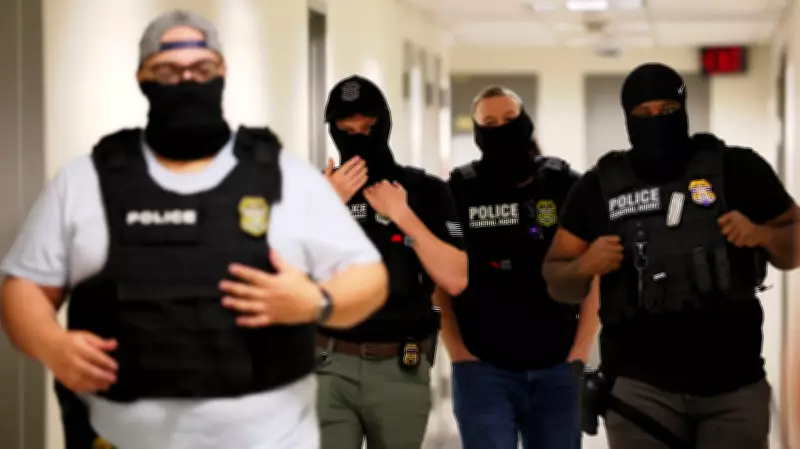
Mounting Criticism Targets ICE's Masked Enforcement Operations
Criticism over Immigration and Customs Enforcement's aggressive handling of immigration operations continues to intensify across the United States. The controversy centers on the agency's widespread practice of having agents wear face coverings during enforcement actions, a departure from standard American law enforcement protocols.
Fatal Shooting in Minnesota Fuels Legislative Response
Over the weekend in Minnesota, which has become the focal point of recent federal immigration operations, a second Minneapolis resident was fatally shot by federal agents. Alex Pretti's death has amplified existing concerns about ICE's methods in the region, where operations have been ongoing for the past month.
"Minnesota should not be a place where people are abducted off the street by masked, unidentified men in unmarked vans," declared Minnesota State Representative Leigh Finke. In response to these incidents, Finke introduced two separate bills this week aimed at requiring ICE agents to reveal their identities during operations.

"What we are seeing right now isn't standard law enforcement ― it is a paramilitary-style occupation that relies on fear and anonymity to bypass accountability," Finke emphasized in a formal statement.
California Takes Legislative Action Against Masked Enforcement
California, where ICE operations have persisted since summer, implemented a new law on January 1 that prohibits federal officers from wearing masks while on duty. However, this legislative move faces legal challenges, with the U.S. Justice Department currently suing to block the measure from taking effect.
The Department of Homeland Security defends the mask-wearing practice, citing concerns about officer safety. According to DHS statements, agents have faced threats, harassment, and online "doxxing" incidents, with the agency reporting an increase in violence against officers performing their duties.
Psychological Impact of Anonymity in Law Enforcement
Social psychologist and conflict resolution expert Jeremy Pollack explained the psychological dynamics at play when law enforcement officers conceal their identities. "When officers are masked and unidentified, everyone's stress level goes up — officers and civilians alike — and that can increase the risk of negative outcomes," Pollack noted.
Research in social psychology demonstrates that anonymity can significantly alter behavior. "When people feel anonymous, they may feel less personally responsible, take risks they wouldn't take if they were clearly identifiable, and act more aggressively in tense situations," Pollack told HuffPost.
He further elaborated that while masks alone don't automatically cause violence, "anonymity can lower the mental brakes that normally slow people down. When officers are clearly identifiable, they know their actions can be reviewed later."
Historical Context and Legal Precedents
Gabriel J. Chin, a professor specializing in criminal law, immigration, and race at UC Davis, provided historical perspective on mask-wearing in American law enforcement. "It's highly unusual for law enforcement in the U.S. to wear masks," Chin observed. "We're more likely to see it in countries with more violence and crime, where law enforcement officers sometimes wear masks to avoid retaliation by gangs or other non-governmental forces."
Chin pointed to troubling historical parallels, noting that mask-wearing has historically been associated with vigilante groups and racial terrorists like the Ku Klux Klan. The Enforcement Act of 1871, commonly known as the Ku Klux Klan Act, specifically criminalized individuals going "in disguise on the highway, or on the premises of another, with intent to prevent or hinder his free exercise or enjoyment of any right or privilege."
"This is because the KKK wore masks to avoid accountability for their conduct," Chin explained.

Accountability and Transparency Concerns
Legal precedents support the principle of identifiable law enforcement. During a notable case involving NYPD officers challenging nameplate requirements, the court ruled decisively: "A police officer possesses no right of anonymity while in uniform in the face of the public right to know the identity of a public officer, particularly one who is armed and invested with such awesome authority."
Chin suggested that while mask-wearing is often justified as protection against doxxing, the practice may be widespread because "immigration enforcement operations often skirt legal lines and they help insulate officers from legal consequences."
These concerns about identification extend beyond ICE agents to protesters as well. Recently, a federal judge in Minnesota criticized Attorney General Pam Bondi for sharing mugshots of arrested protesters while their cases remained ongoing.
Broader Implications for Enforcement Practices
Chin emphasized that masking represents just one aspect of a larger pattern. "Masking may play a role in the overall approach and aggression," he acknowledged, "but many other factors matter as well — including leadership decisions about operations, guidance the officers are given about the scope of their authority, the unpopularity of their work, and the force they're permitted to use."
As the debate continues, the fundamental question remains how to balance officer safety with public accountability in immigration enforcement operations that have become increasingly visible and controversial across multiple states.





