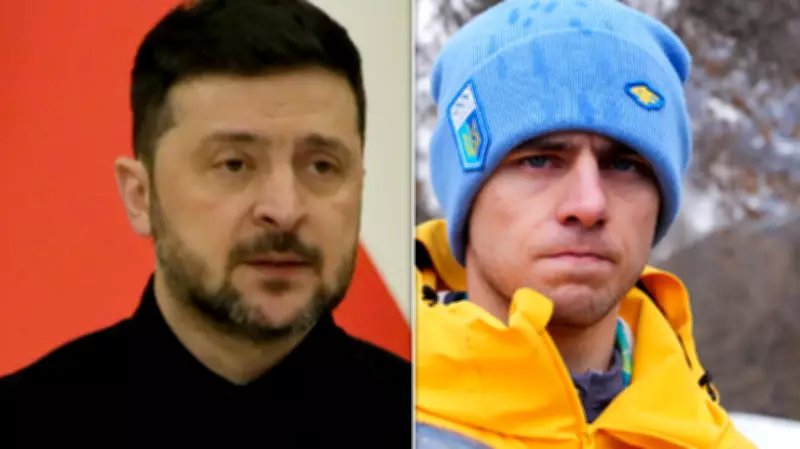
Ukrainian President Condemns IOC Decision on Disqualified Skeleton Racer
Ukrainian President Volodymyr Zelenskiy has publicly criticized the International Olympic Committee's (IOC) recent decision to disqualify skeleton racer Vladyslav Heraskevych, stating that it contradicts the fundamental spirit of the Olympic Games. In a post on the social media platform X, Zelenskiy expressed his strong disapproval, emphasizing that sports should not foster forgetfulness and that the Olympic movement ought to contribute to ending conflicts rather than aiding aggressors.
Zelenskiy's Statement on Social Media
"Sport shouldn't mean amnesia, and the Olympic movement should help stop wars, not play into the hands of aggressors," Zelenskiy wrote. He further elaborated, "Unfortunately, the decision of the International Olympic Committee to disqualify Ukrainian skeleton racer Vladyslav Heraskevych says otherwise." The president highlighted that Heraskevych's helmet, which featured images of Ukrainian athletes who have been killed in the ongoing war, serves as a poignant reminder of Russian aggression. Zelenskiy asserted that no rules were broken by the athlete, reinforcing his stance that the disqualification is unjust.
Background on the Disqualification
The incident centers on Vladyslav Heraskevych, a Ukrainian skeleton competitor, who was disqualified by the IOC. The decision has sparked controversy, with Zelenskiy arguing that it overlooks the broader context of the war in Ukraine. The helmet in question, adorned with tributes to fallen Ukrainian athletes, was intended to honor their memory and draw attention to the conflict's human cost. Zelenskiy's comments underscore a growing tension between athletic regulations and political expressions during international sports events.

Implications for the Olympic Movement
This dispute raises important questions about the role of the Olympic Games in addressing global conflicts. Zelenskiy's criticism suggests that the IOC's actions may be perceived as insensitive to the plight of nations embroiled in war. By disqualifying Heraskevych, the IOC has inadvertently ignited a debate on whether sports organizations should accommodate political messages that highlight humanitarian crises. The Ukrainian president's remarks call for a reevaluation of how the Olympic movement balances its rules with its stated values of peace and unity.
Reactions and Future Outlook
The disqualification has garnered attention beyond Ukraine, prompting discussions among sports analysts and human rights advocates. While the IOC has not publicly responded to Zelenskiy's comments, the issue may influence future policies regarding athlete expressions at Olympic events. As the conflict in Ukraine continues, such incidents highlight the intersection of sports and politics, challenging the neutrality often associated with international competitions. The outcome of this controversy could set a precedent for how similar cases are handled in the future.