

Ontario Health Care Expenditure Surges 50 Percent Under Current Administration
Windsor-Tecumseh MPP Andrew Dowie has revealed that health care spending in Ontario has increased by a substantial 50 percent since Premier Doug Ford assumed office. According to Dowie, annual health expenditures have risen from $60 billion to $90 billion under the current government's tenure.
Addressing Protest Concerns and Misleading Claims
Dowie made these statements while responding to approximately 20 protesters who gathered at his office on Saturday as part of the "Fire Ford February" campaign organized by the Council of Canadians. The demonstrators carried symbolic tombstones representing what they claimed were the demise of various longstanding Ontario institutions.
"The points they raise are misleading to the public," Dowie asserted. "They reflect an inaccurate perspective and envision a future that's bleak, which is not at all what's happening."

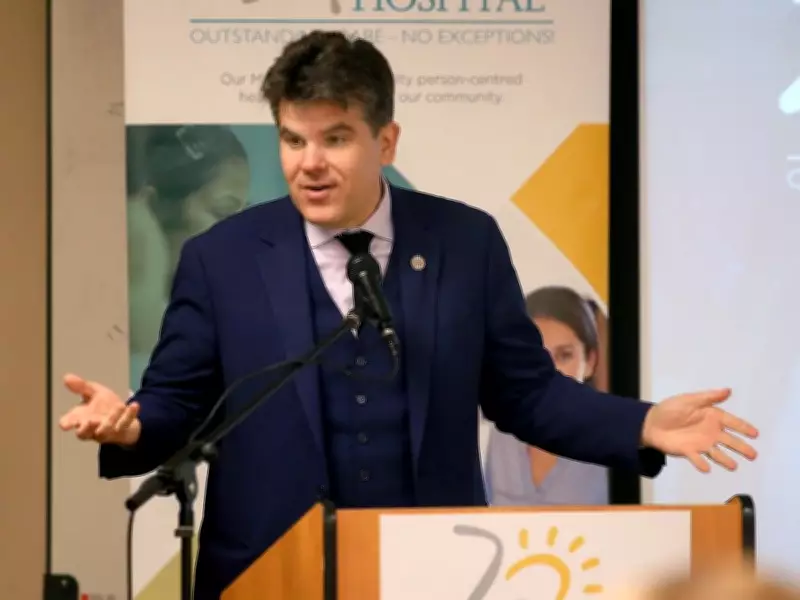
The Progressive Conservative MPP emphasized that while the significant funding increase demonstrates substantial investment in health care, he acknowledged that challenges persist. "Is anyone satisfied? No, but I think it also proves the solutions aren't all about money," Dowie commented during the press conference held at Windsor Regional Hospital's Met campus on February 3, 2026.
Specific Government Initiatives and Funding Allocations
The provincial government has committed substantial resources to various programs, including:
- $2 million investment in Windsor's Hospital To Home (H2H) program
- $1.1 billion pledged provincewide over three years for home and community care
- More than $4 million announced in 2023 to address housing and homelessness in Windsor-Essex, representing approximately a 30 percent increase to annual funding
Despite these investments, Dowie noted that visible improvements in homelessness situations remain elusive. "But I have yet to see an improvement in our homelessness situation," he admitted.
Defending Private Clinic Expansion and Long-Term Care
Dowie addressed concerns about the establishment of private orthopedic clinics for hip and knee surgeries, including one planned for Windsor. He clarified that these facilities have not resulted in a "raid" on public health care nursing staff because their operational model differs significantly from traditional hospitals.
"Their model is based on doing one thing repetitively, so they don't need a nurse with a variety of skill sets. They just need technicians," Dowie explained.
Regarding long-term care facilities, Dowie countered claims that not-for-profit options are declining. "Which one has been closed? In fact, there are conversations about opening a new one that's not-for-profit," he stated.
Conservation Authority Reorganization Plans
The MPP also addressed concerns about conservation authorities, assuring that they will not disappear despite reorganization plans announced in October. The province intends to merge 36 existing authorities into seven consolidated entities.
- Essex Region Conservation Authority will merge with seven others
- The new entity will be called the Lake Erie Conservation Authority
- Local municipal control will be maintained
- Funding will continue through property tax mechanisms
"There will still be local, municipal control of it. Also it will be funded through property tax," Dowie emphasized.
Political Support and Community Representation
Dowie challenged the protesters' claim to represent community interests, pointing to electoral results as evidence of broader public support. "They say they're speaking for the community. They're not, because more people actually showed up to the polls and voted for me than voted for anybody else in the last election, and in larger numbers," he remarked.
The MPP characterized the protesters as a consistent group with recurring grievances, describing their complaints as a predictable "litany" rather than representative of broader community sentiment.






