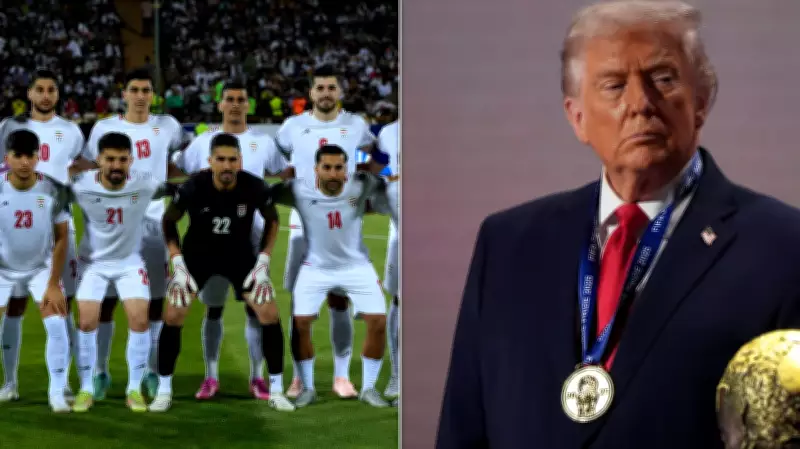
In a move that highlights the complex interplay between sports and international politics, former President Donald Trump issued a notably contradictory invitation to Iran's national soccer team on Thursday regarding their potential participation in the 2026 FIFA World Cup. Trump's statement, shared via a social media post, extended a welcome while simultaneously urging caution, reflecting the heightened tensions following recent military actions by the United States and Israel against Iran.
Trump's Dual-Message Post
"The Iran National Soccer Team is welcome to The World Cup, but I really don't believe it is appropriate that they be there, for their own life and safety," Trump wrote. He concluded with a formal sign-off: "Thank you for your attention to this matter! President DONALD J. TRUMP." This ambiguous stance comes nearly two weeks after the attacks, underscoring the precarious security situation in the region.
Iran's Official Stance on World Cup Participation
Just one day prior to Trump's comments, Iran's sports minister announced that the national team would be barred from competing in the tournament. The decision was attributed to the ongoing conflict and the assassination of Supreme Leader Ayatollah Ali Khamenei. "Considering that this corrupt regime has assassinated our leader, under no circumstances can we participate in the World Cup," the minister stated in an interview with state television, as reported by Reuters.

Historical Context of Iran's World Cup Appearances
Iran's national soccer team has a storied history in the FIFA World Cup, having participated in six tournaments to date. Their most recent appearance was in the 2022 FIFA World Cup held in Qatar, where they finished third in Group B, trailing behind the United States and England. The team made its debut in 1978, coinciding with the Islamic Revolution, marking a significant moment in both sports and national history.
Humanitarian Developments for Iranian Women's Soccer
Amidst these diplomatic and sporting tensions, a separate humanitarian issue emerged involving Iran's national women's soccer team. Earlier this week, CNN reported that seven members of the team were granted humanitarian visas in Australia. This occurred after the team traveled to the Women's Asian Cup prior to the U.S. and Israeli strikes on Iran.
The visas were issued to six players and one support staff member, who opted not to return to Iran due to fears of persecution. Australian Home Affairs Minister Tony Burke confirmed to CNN that the remainder of the team departed Sydney on Tuesday, highlighting the personal risks faced by athletes in times of political turmoil.
Broader Implications for Sports and Diplomacy
The juxtaposition of Trump's invitation and Iran's official withdrawal raises critical questions about the role of sports in international relations. Key points include:
- The potential for sports events to serve as platforms for diplomatic engagement or conflict.
- The safety concerns for athletes competing in politically volatile environments.
- The impact of geopolitical tensions on global sporting competitions like the FIFA World Cup.
As the 2026 World Cup approaches, these developments underscore the intricate balance between athletic participation and national security, with Iran's situation serving as a poignant case study in how sports can become entangled with broader geopolitical narratives.