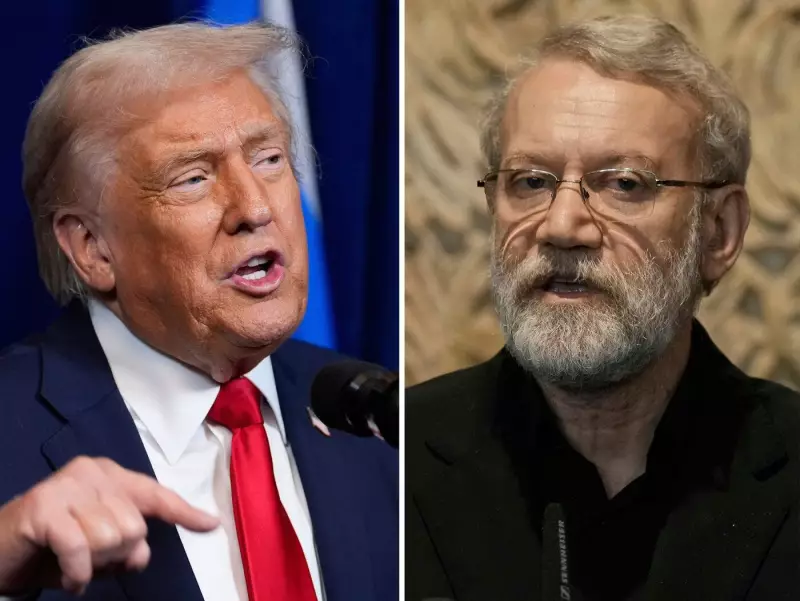
Former United States President Donald Trump and high-ranking officials from Iran have engaged in a public exchange of threats, centering on the widespread protests currently destabilizing the Islamic Republic. The verbal clash underscores the enduring geopolitical friction between Washington and Tehran, even as Iran grapples with significant internal dissent.
A War of Words Escalates
The confrontation began with statements from Trump, who has maintained a hardline stance against Iran since his presidency. He issued a stark warning directed at the Iranian leadership, linking the domestic unrest to their governance. In response, Ali Larijani, the Secretary of Iran's Supreme National Security Council, fired back with a threat of his own, demonstrating the regime's refusal to tolerate external commentary on its internal affairs.
This diplomatic skirmish is not occurring in a vacuum. It comes against a backdrop of sustained protests within Iran, driven by a complex mix of economic hardship, social restrictions, and political discontent. The Iranian government has historically framed such demonstrations as instigated by foreign adversaries, a narrative it is reinforcing in the face of criticism from figures like Trump.

The Domestic Context in Iran
The protests referenced in the exchange have been roiling the country for some time, presenting one of the more serious challenges to the ruling establishment in recent years. While the precise catalysts vary, common grievances include inflation, unemployment, and stringent social laws. The government's response has involved both attempts at suppression and rhetoric blaming outside forces for fomenting chaos.
Larijani's role as the head of the key security council places him at the center of Iran's strategy for managing both internal dissent and external threats. His direct rebuttal to Trump signals that Tehran views the former U.S. president's comments as a form of interference and a potential justification for further crackdowns on protesters, whom they may label as agents of foreign powers.
Broader Implications for International Relations
This episode highlights the fragile and adversarial state of U.S.-Iran relations, which have seen little improvement. The public threats risk further inflaming tensions and could complicate any behind-the-scenes diplomatic efforts. For the international community, the situation presents a dilemma: how to respond to human rights concerns within Iran without providing the regime with propaganda fodder to blame the West for its troubles.
Analysts suggest that such exchanges may harden positions on both sides. For Trump and his political allies, it reinforces a narrative of a defiant Iran requiring a firm hand. For the Iranian leadership, it offers an opportunity to rally nationalist sentiment by portraying the country as under siege from its long-standing enemy.
The coming days will be critical in observing whether this war of words remains rhetorical or influences actions on the ground in Iran. The focus remains on the Iranian people, whose protests ignited this latest international confrontation, and who continue to face an uncertain and precarious situation.