Rafah Border Crossing Reopens Under Ceasefire, But Traffic Remains Limited
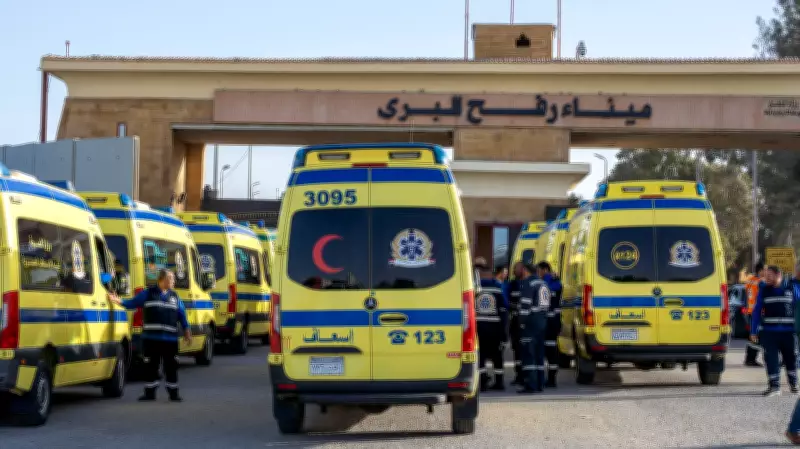
The Rafah border crossing between Gaza and Egypt reopened on Monday, marking a key development in the ongoing Israel-Hamas ceasefire agreement. However, the reopening is largely symbolic for now, as only limited passenger traffic is being allowed in either direction, and no commercial goods are permitted to pass through the crucial gateway.
Initial Operations and Medical Evacuations
Within the first hours of operation, no crossings were observed, though Egyptian officials indicated that approximately 50 Palestinians were expected to travel in each direction on the opening day. This limited capacity comes amid significant need, with Gaza health officials reporting that about 20,000 Palestinian children and adults require urgent medical evacuation through Rafah. Additionally, thousands of Palestinians outside the territory hope to return home via the crossing.
Rajaa Abu Mustafa, waiting outside a Gaza hospital with her 17-year-old son Mohamed who was blinded while seeking food aid last year, expressed cautious hope. "We have been waiting for the crossing to open," she said. "Now it's opened and the health ministry called and told us that we will travel to Egypt for his treatment."

Egypt's Preparedness and Security Arrangements
Egyptian authorities have prepared extensively for the reopening, with about 150 hospitals across Egypt ready to receive Palestinian patients. The Egyptian Red Crescent has also established safe spaces on the Egyptian side of the border to support evacuees from Gaza.
The crossing will operate under strict security protocols, with Israel and Egypt jointly vetting all individuals seeking to cross. European Union border patrol agents will supervise operations, with minimal Palestinian presence. Travel numbers are expected to increase gradually if the system proves successful.
Ongoing Violence and Casualty Figures
Despite the ceasefire, violence continued in Gaza on Monday. Hospital officials reported that an Israeli navy ship fired on a tent camp in Khan Younis, killing a 3-year-old Palestinian boy. Israel's military stated it was investigating the incident.
According to Gaza's health ministry, more than 520 Palestinians have been killed by Israeli fire since the ceasefire took effect on October 10. These casualties, which UNICEF reports include over 100 children, are part of the more than 71,700 Palestinians killed since Israel's offensive began. The ministry's records, maintained by Gaza's Hamas-led government, are generally considered reliable by UN agencies and independent experts.
Historical Context and Ceasefire Progress
Before the war, Rafah served as Gaza's primary crossing for people moving in and out of the territory. Israel seized control of the crossing in May 2024 as part of efforts to combat arms-smuggling for Hamas. It was briefly opened during a ceasefire in early 2025 for medical evacuations.
The current reopening represents significant progress in the US-brokered ceasefire agreement, which entered its second phase following the recovery of the last hostage remains in Gaza. The truce halted more than two years of conflict that began with Hamas's attack on southern Israel on October 7, 2023.
The second phase of the ceasefire deal involves complex implementation, including establishing a new Palestinian committee to govern Gaza, deploying an international security force, disarming Hamas, and initiating reconstruction efforts. If the ceasefire holds, Rafah operations are expected to gradually expand over time.