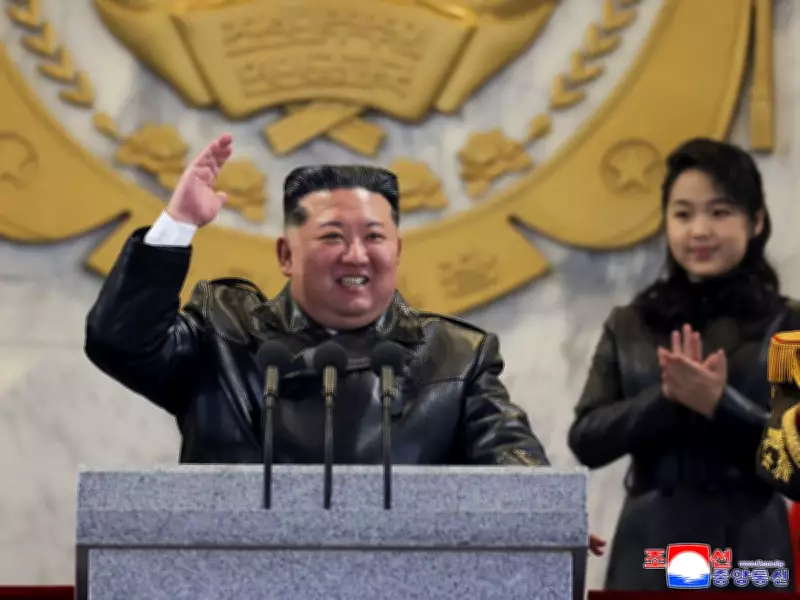
North Korean leader Kim Jong Un has delivered a significant diplomatic statement, indicating potential openness to improved relations with the United States while simultaneously declaring a complete severance of ties with South Korea. The remarks came as the landmark congress of North Korea's ruling Workers' Party concluded this week, revealing a strategic shift in Pyongyang's foreign policy approach.
Conditional Openness to Washington
According to state media reports from Thursday, Kim Jong Un stated that North Korea could "get along well" with the United States under specific conditions. The primary requirement articulated by the North Korean leader is Washington's formal acknowledgment of North Korea's nuclear status as established in the country's constitution.
"If Washington respects our country's current nuclear status as stipulated in the Constitution and withdraws its hostile policy, there is no reason why we cannot get along well with the United States," Kim declared through the Korean Central News Agency.

This statement represents a notable departure from previous diplomatic positions and comes amid growing speculation about a potential meeting between Kim and former U.S. President Donald Trump. During his Asia tour last year, Trump expressed being "100 percent" open to such a meeting, even breaking with decades of American policy by acknowledging North Korea as "sort of a nuclear power."
Complete Rejection of South Korea
In stark contrast to his conditional openness toward Washington, Kim adopted an uncompromisingly hostile stance toward South Korea. The North Korean leader described Seoul as his country's "most hostile entity" and announced that it would be permanently excluded "from the category of compatriots."
"North Korea has absolutely no business dealing with South Korea, its most hostile entity, and will permanently exclude South Korea from the category of compatriots," Kim stated unequivocally.
He further elaborated that as long as South Korea shares a border with North Korea, "the only way to live safely is to give up everything related to us and leave us alone." This represents a significant hardening of position toward Seoul and suggests Pyongyang's intention to pursue relations with Washington independently, without South Korean mediation.
Strategic Implications and Expert Analysis
Yang Moo-jin, former president of the University of North Korean Studies, analyzed that North Korea's latest remarks "signal an intention to pursue relations with the U.S. independently, without going through South Korea." He added that Kim is making clear he will "reject any negotiations premised on denuclearization."
The nuclear program has remained North Korea's foremost priority for decades, maintained even during periods of severe food shortages and famine. Despite high-stakes summits, crippling international sanctions, and prolonged diplomatic pressure, Pyongyang has consistently refused to surrender its nuclear arsenal.
The 2019 Hanoi summit between Kim and Trump collapsed when the two leaders failed to reach agreement on sanctions relief and corresponding nuclear concessions. A potential future meeting between the two would represent a major breakthrough after years of diplomatic stalemate.
Regional Alignments and Military Posturing
Kim Jong Un's diplomatic positioning occurs against a backdrop of strengthened regional alliances. The North Korean leader appeared alongside Chinese President Xi Jinping and Russian President Vladimir Putin at a grand military parade in Beijing last year, demonstrating his powerful international connections and elevated global status.
Pyongyang has particularly deepened its relationship with Moscow, sending thousands of troops to support Russia's military operations in Ukraine. This military cooperation represents a significant development in North Korea's foreign engagements.
The Workers' Party congress concluded with a "grand" military parade, underscoring the event's importance in directing state efforts across all domains, from foreign policy formulation to comprehensive war planning. This display of military strength serves as a reminder of North Korea's capabilities even as diplomatic overtures are made toward Washington.

The dual nature of Kim's statements—conditional openness to the United States coupled with complete rejection of South Korea—creates a complex diplomatic landscape that will require careful navigation by all parties involved in Northeast Asian security dynamics.