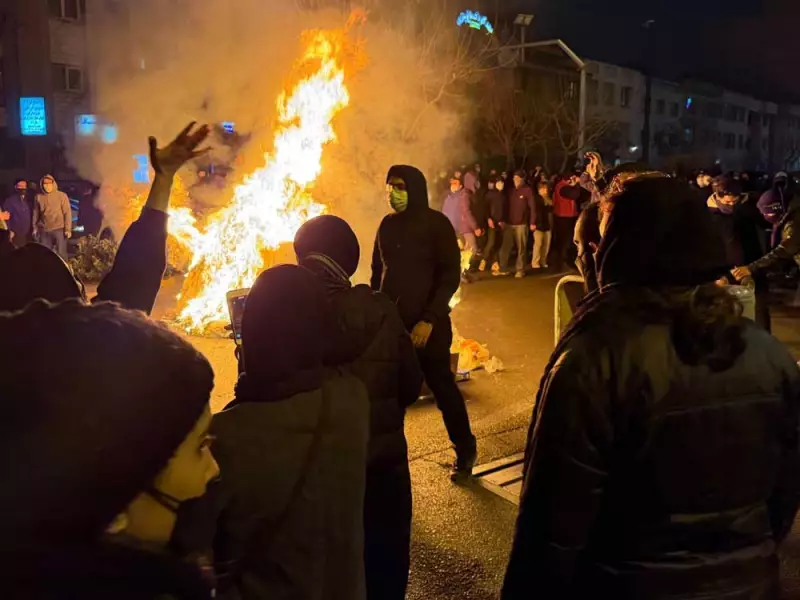
Massive nationwide protests inside Iran have created a pivotal opening that could fundamentally reshape the security landscape of West Asia and beyond, according to a detailed analysis. The sustained demonstrations, which continued into early January 2026, represent not just a domestic struggle for political freedom but a moment of profound international consequence.
A Regime Built on Repression and Export of Instability
For over four decades, the Islamic Republic has been a primary source of regional instability, engaging in confrontations with global powers like Israel and the United States. The regime's strategy has relied on systematic financial and military support for armed non-state actors, including Hezbollah and Hamas. This sustained export of violence and ideological extremism has consistently undermined both regional and global security frameworks.
The current uprising, marked by Iranians taking to the streets in huge numbers, directly challenges a state whose survival has depended on domestic repression and international disruption. The author, Ardeshir Zarezadeh, writes from a unique perspective as a former Iranian student leader, political prisoner, and a human rights advocate now based in Canada. He warns that the regime's reliance on violence has never been confined within Iran's borders, noting its cultivation of transnational networks and attempts to influence political discourse in democracies like Canada and the U.S. through intimidation and foreign interference.

International Dynamics Shift as Regime's Control Erodes
The internal crisis is now intersecting sharply with international power calculations. Several U.S. policymakers, including Senators Ted Cruz and Lindsey Graham, view this moment as a rare opportunity for a decisive confrontation with the Islamic Republic. Inside Iran, protesters have reportedly chanted the name of U.S. President Donald Trump and called for foreign intervention, with some streets even being renamed in his honour.
In a significant shift reflecting its growing vulnerability, the Islamic Republic, after years of publicly rejecting talks with Washington, has now reached out to the Trump administration seeking negotiations. President Trump has stated that the use of lethal force against protesters would trigger consequences and has consistently identified Supreme Leader Ali Khamenei as a major threat to security in the U.S., Israel, and the broader Middle East. While Trump has pledged support for the Iranian people, he has not yet met with Prince Reza Pahlavi, a figure many protesters see as a potential representative for a transitional government.
The Legal Imperative: Crimes Against Humanity and R2P
The scale and nature of the state's response to the protests meet a critical legal threshold. The widespread and systematic attacks against unarmed civilians constitute crimes against humanity under international law. This triggers not merely moral condemnation but concrete legal responsibility.
The principle of the Responsibility to Protect (R2P), unanimously endorsed by all United Nations member states at the 2005 World Summit, becomes directly relevant. This doctrine states that when a state is unwilling or unable to protect its population from such atrocities, the responsibility shifts to the international community to respond with appropriate measures. Sovereignty, in this context, is conditional and does not grant a licence to kill.
This presents democratic nations, including Canada, the U.S., and the U.K., with a stark choice. They can either allow a cycle of repression and impunity to be reinforced through bloodshed, or they can act lawfully to prevent mass killings by helping to dismantle a system built on terror. The courage of the Iranian people is already evident on the streets. The unresolved question is whether the international community will recognize this uprising as a definitive test of the rules-based order it claims to defend.
History's judgment, as Zarezadeh concludes, will hinge on whether decisive action preceded further killing, not just on statements of concern. The world is watching a potential turning point not only for Iran but for the enforcement of global human rights norms.