Carney's Parliamentary Exchange Proposal with China Faces Sanctions Obstacle
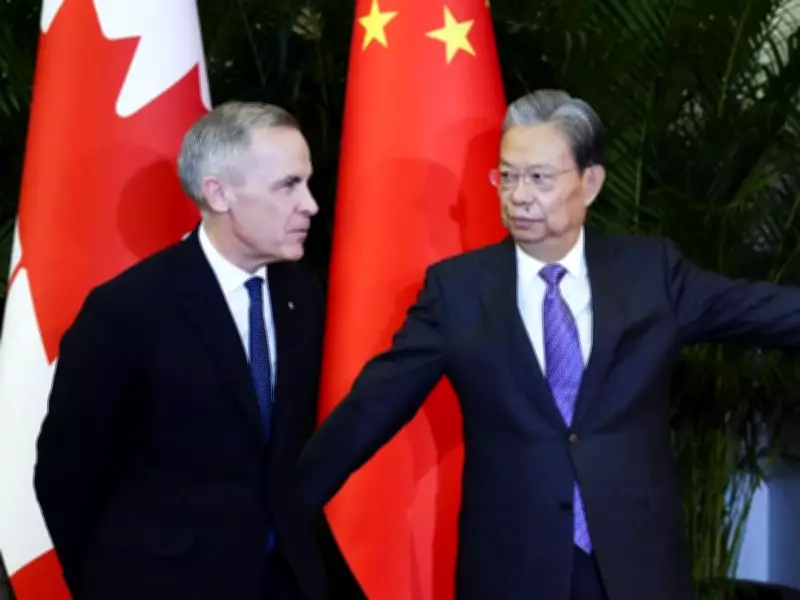
During his recent diplomatic visit to Beijing, Prime Minister Mark Carney engaged in discussions with Zhao Leji, the third-ranking member of the Chinese Communist Party Politburo and chair of the standing committee of the National People's Congress. The official readout from their January meeting emphasized the importance of ongoing parliamentary exchanges and opportunities for enhanced understanding between the two nations.
Sanctioned MPs Create Diplomatic Impasse
The immediate complication arises from China's formal request last week for its parliamentary committee members to visit Ottawa. This invitation presents a significant problem because numerous Canadian parliamentarians remain under Chinese sanctions that prohibit their entry into China and Hong Kong. Conservative MP Michael Chong and Bloc MP Alexis Brunelle-Duceppe, both vice-chairs of Canada's Foreign Affairs committee, are among those affected by these restrictions.
The sanctions originated in 2021 when China targeted the entire House of Commons subcommittee on international human rights after it accused China of committing genocide against Muslim groups in Xinjiang. Other current MPs still under these sanctions include NDP's Heather McPherson, Liberal MPs Iqra Khalid and Anita Vandenbeld, and Trade Minister Maninder Sidhu.

Contrast with British Resolution
This situation creates what observers describe as a ludicrous scenario where sanctioned Canadian MPs who might travel to China at the invitation of the National People's Congress could face detention. The contrast with Britain's recent diplomatic success is particularly striking. When Prime Minister Keir Starmer visited Beijing last month, he successfully negotiated the removal of all restrictions on British MPs who had faced similar sanctions.
It appears Carney did not achieve comparable concessions during his discussions, leaving Canadian parliamentarians in diplomatic limbo. Liberal committee chair Ahmed Hussen is reportedly preparing a response that will clarify Canada's position: there will be no parliamentary exchanges until full reciprocity is established.
Broader Diplomatic Context
The diplomatic standoff occurs against a complex geopolitical backdrop. China appears to be seeking advantage from what some analysts describe as the Trump administration's mishandling of traditional alliances. While diplomatic engagement generally represents a preferable alternative to conflict, as Winston Churchill famously noted, the current situation requires careful navigation of fundamental differences in governance systems.
The concept of "parliamentary exchanges" itself creates what critics call a false equivalency. The standing committee of the National People's Congress operates under "democratic centralism," with members selected from Communist Party-controlled lists. While it translates party vision into laws and policies, it does not challenge top-level officials in the manner of Western parliamentary systems.
Path Forward and Historical Precedents
Canada's position remains firm regarding the sanctions it imposed in 2021 concerning the Uyghur mass incarceration. The diplomatic path forward requires resolution of this sanctions issue before meaningful parliamentary exchanges can proceed. Historical research into diplomatic engagements with authoritarian regimes, including work on former justice minister Irwin Cotler's experiences, suggests that discussions with despotic governments can sometimes yield positive outcomes when approached with clear principles and reciprocity.
The current impasse highlights the delicate balance between diplomatic engagement and maintaining principled positions on human rights and international law. As both nations navigate this complex relationship, the resolution of the sanctions issue will serve as a crucial indicator of whether substantive parliamentary exchanges can develop between Canada and China in the coming months.