U.S.-Israel Joint Strike on Iran Splits GOP: War Powers Debate Ignites
The United States, in a joint military operation with Israel, launched early Saturday morning attacks against Iran, an action that has sharply divided the Republican Party. While some prominent Republicans have praised President Donald Trump for the move, others have issued strong warnings against the possibility of the nation being drawn into another foreign war.
Constitutional Concerns and 'America First' Backlash
Leading the criticism from within the GOP is Representative Thomas Massie, a Republican from Kentucky. Massie took to social media platform X to declare his opposition, stating, "I am opposed to this War. This is not 'America First.'" He announced that he, along with Democratic Representative Ro Khanna of California, would force a congressional vote on the matter. "The Constitution requires a vote, and your Representative needs to be on record as opposing or supporting this war," Massie asserted, framing the strikes as "Acts of war unauthorized by Congress."
This constitutional argument was echoed by Senator Rand Paul, also a Republican from Kentucky. Paul stated that "yet another preemptive war" had begun in the Middle East, emphasizing that the Founding Fathers deliberately placed the power to declare war with Congress to make such conflicts less likely. "As with all war, my first and purest instinct is wish American soldiers safety and success in their mission," Paul wrote. "But my oath of office is to the Constitution, so with studied care, I must oppose another Presidential war."

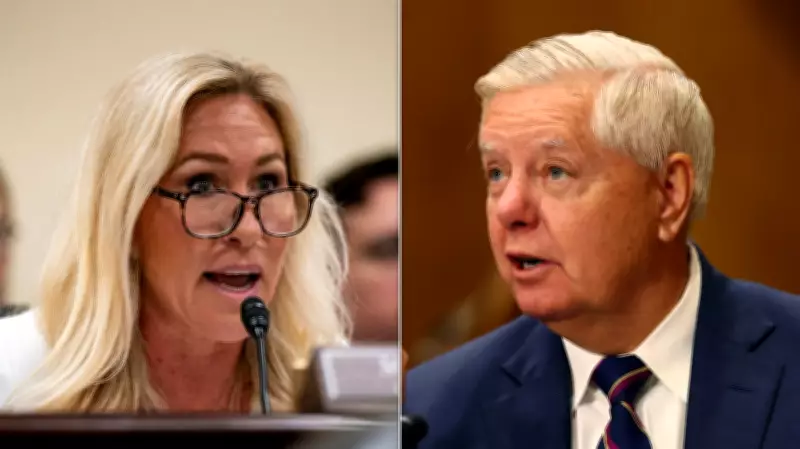
The operation, which the Defense Department is calling "Operation Epic Fury," also drew fierce rebuke from other high-profile conservatives who align with the "America First" ideology. Former Representative Marjorie Taylor Greene of Georgia unleashed a series of posts on X, criticizing the Trump administration for allegedly polling voters on acceptable casualty numbers. "How about ZERO you bunch of sick fucking liars. We voted for America First and ZERO wars," she wrote. Conservative commentator Tucker Carlson reportedly condemned the attack as "absolutely disgusting and evil."
Trump's Announcement and Loyalist Support
President Trump announced the commencement of "major combat operations in Iran" on Saturday. In his address, he seemed to advocate for regime change, urging the Iranian public to "take over" their government. He justified the action by claiming Iran continues to develop its nuclear program with the intent to build missiles capable of reaching the United States.
"My administration is taking every possible step to minimize the risk to U.S. personnel in the region. Even so, and I do not make this statement lightly, the Iranian regime seeks to kill," Trump said. "The lives of courageous American heroes may be lost, and we may have casualties. That often happens in war. But we're doing this not for now. We're doing this for the future. And it is a noble mission."
This stance garnered full-throated support from several Republican leaders. Senator Lindsey Graham of South Carolina hailed Trump's speech, predicting it "will go down in history as the catalyst for the most historic change in the Middle East in a thousand years." Graham echoed the president's call for the Iranian military and people to rise up, stating, "President Trump was right when he said he's the first president in 47 years to stand with the people of Iran and give them the backing they need."
Senator Katie Britt, a Republican from Alabama, offered her complete support in a statement, calling the operation "a defining moment of generational leadership from President Trump to achieve sustainable peace." Representative Nancy Mace, a Republican from South Carolina, simply posted, "History will record this night," adding that Trump understood that "peace is not found in appeasement - it is won."

A Party at a Crossroads
The dramatic split within the Republican Party highlights a fundamental tension between executive authority and congressional war powers, a debate reignited by this sudden military engagement. The reaction spans from constitutional purists and anti-interventionists warning of unauthorized conflict to staunch Trump loyalists framing the action as bold, necessary leadership for long-term regional stability. As "Operation Epic Fury" unfolds, this internal GOP rift over the scope of presidential power and the path to national security promises to define the political landscape in the days ahead.