Canada used to be a bilingual country, where institutions could accommodate speakers of either official language. That era came to a resounding close on Friday, when a majority of the Supreme Court banned the appointment of unilingual speakers to a bilingual government office.
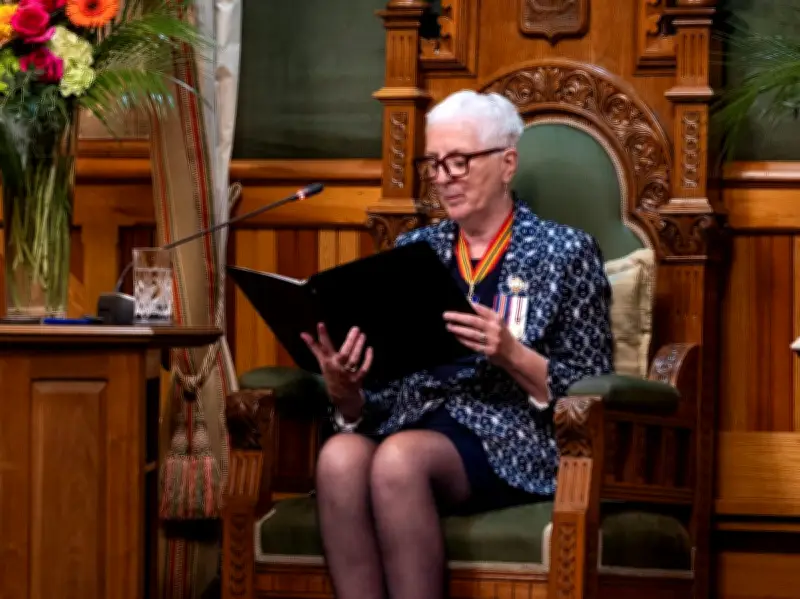
The case before the court had been brought by an Acadian activist group that challenged the appointment of a non-French-speaker, Brenda Murphy, to the position of lieutenant governor of New Brunswick. Six of the Supreme Court’s nine judges agreed with the Acadians, concluding that the lieutenant governor must speak both English and French. Appointing an anglophone, they said, constituted a violation of the Charter, in particular the equality rights of francophones.
Chief Justice Wagner's Reasoning
“Where an institution is unipersonal, where some of the institution’s constitutive functions cannot be delegated and where it publicly expresses itself through the person embodying it, equality of status cannot be achieved in the institution unless that person is able to understand and speak each of the two official languages,” wrote Chief Justice Richard Wagner for the majority. This is the first time the term “unipersonal” has been used by a Canadian court.

The rule going forward is this: to fulfill the Charter right to the “substantive equality” of francophones, government appointees must be bilingual in cases where the institution of their office “is constitutionally inseparable from its sole office holder,” where their role is “uniquely symbolic” and where their functions “cannot be performed by anyone else.”
Implications for Appointments
The lieutenant governor of New Brunswick is “one such institution,” Wagner concluded. The chief justice didn’t go as far as invalidating Murphy’s appointment, though, as her term ended in January 2025. Wagner further supported his proclamation by pointing to the means of selecting the office-holder. With democratic representatives, the population can reject unilingual candidates in an election. With office-holders who are appointed, voters have no such recourse. He ignored the fact that his own unelected and unaccountable self had just assumed the power of kings, deciding who is eligible for high office based on his own personal convictions.
Indeed, there is nothing in the Constitution that actually supports Wagner’s new belief in radical bilingualism: the Constitution Act of 1867 is clear that it’s the governor general’s job to appoint the lieutenant governor of New Brunswick; it doesn’t specify anything about the individual’s linguistic abilities. Wagner saw a blank and filled it in with the Constitution Act of 1982, in particular the part that states, “English and French are the official languages of New Brunswick and have equality of status and equal rights and privileges as to their use in all institutions of the legislature and government of New Brunswick.” He massaged this into an invisible wall barring Canada’s head of state from selecting an anglophone lieutenant governor.
“Language rights serve a threefold purpose: preventive, remedial and unifying,” went his justification. “Their interpretation must take into account the historical wrongs that made their entrenchment necessary, and it must be anchored in the social, demographic and historical realities specific to each province.”