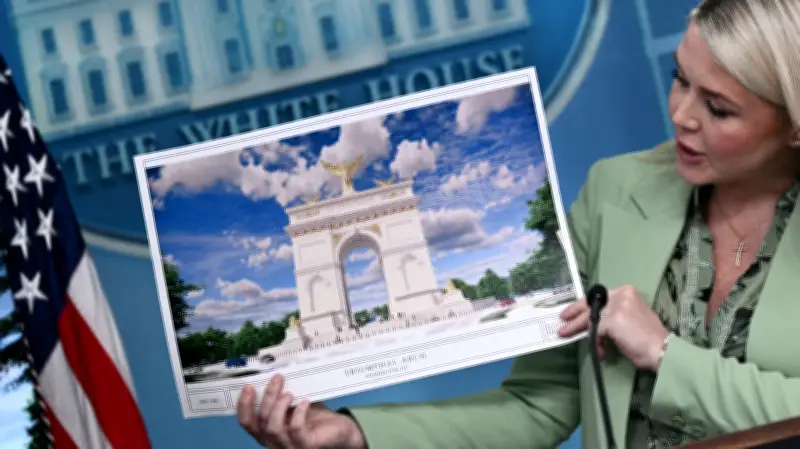
President Donald Trump has focused so much of his second term on large-scale building projects that it is often hard to keep track of each proposal. Now his planned 250-foot triumphal arch near Arlington National Cemetery is back in the spotlight after the Commission of Fine Arts, made up of Trump appointees, voted last month to approve designs for the project. Critics of the arch, estimated to cost at least $100 million, have called it a "vanity project" aimed at serving the president's ego. The gargantuan gilded design has also elicited comparisons to North Korea's 197-foot Arch of Triumph and the 246-foot golden monument in Turkmenistan featuring a statue of dictator Saparmurat Niyazov.
Following the vote on Trump's arch, House Democrats introduced a bill to block its construction and the use of any federal funds to pay for it. Like many of Trump's architectural endeavors, the triumphal arch is giving more Cheesecake Factory than civic monument. But to further underscore why the proposal is so controversial, it helps to understand what a triumphal arch actually is and what it has always meant.
Historical Context of Triumphal Arches
"The triumphal arch emerged as a form of monument in ancient Rome to make permanent the status of a conquering emperor as a godlike victor," said Marisa Anne Bass, an art historian and author of "The Monument's End: Public Art and the Modern Republic." "It was meant to permanently commemorate the moment of an emperor's return to the capital city in triumph from wars abroad. In other words, the point was to commemorate an individual, not a nation or even a collective of citizens."

That distinction matters enormously in the American context. Although there are a small number of monumental arches in the United States, their design and meaning are more modest and civically grounded compared to Trump's 250-foot triumphal arch proposal. The arch in New York City's Washington Square Park, built in the late 19th century to commemorate the centennial of the first president's inauguration, stands less than 80 feet tall and features no traces of gold or oversized figures on top. The 80-foot Soldiers' and Sailors' Arch in Brooklyn commemorates American Civil War veterans and is also a much more understated endeavor than the so-called "Arc de Trump."
"The reason that Washington D.C. does not have a triumphal arch is because the United States has never had an emperor or king," Bass said. "In fact, in the history of revolutionary America, Americans famously tore down a statue of King George III of England, and George Washington famously never wanted a statue of himself erected in public view." The precedents in the realm of triumphal arches, she added, are not reassuring. "In the history of art, triumphal arches have always appealed to rulers seeking to instantiate their absolute power," Bass said.
Architectural and Historical Concerns
Bass pointed to Napoleon's Arc de Triomphe in Paris and the Siegestor arch and Propyläen gate in Munich, both commissioned by Bavarian kings, which Hitler used as stages for Nazi propaganda. Hitler also planned to build a nearly 400-foot "German Arch of Triumph" in Berlin. "A triumphal arch is one of the most historically specific forms in architecture," echoed Aaron D. Murphy, owner of ADM Architecture. "It comes directly out of ancient Rome and was later used by figures like Napoleon to celebrate military victory and national power. So when you introduce that form, you are not just choosing a style, you are choosing a very explicit message."
It is a message that has echoed through the history of monuments from the very beginning. As Bass writes in her book, "The history of monuments is largely a history of recurrent forms that reinforce domination. Violence is built into their very design. Liberty is not."
The proposed location for Trump's arch project amplifies every concern about the form itself. "Arlington National Cemetery is one of the most restrained and solemn landscapes in the country," Murphy said. "Its power comes from quiet continuity, not singular dominance. A 250-foot triumphal arch does the opposite. It is designed to be seen, to frame, to declare. It introduces a vocabulary of victory and assertion into a setting defined by remembrance and sacrifice."

That tension explains why the proposal is so controversial. And it is why Murphy finds the context for the project to be a particularly poor fit. "It is not just about aesthetics, it is about whether the architecture is amplifying the meaning of the place or competing with it," Murphy explained. "Historically, triumphal arches mark moments of conquest. Arlington marks the cost of it. Those are fundamentally different narratives. A triumphal arch is designed to celebrate victory. Arlington is designed to honor sacrifice. That is a difficult overlap. In this scenario, it is a form meant to declare something, placed in a setting defined by reflection."
Expert Reactions and Criticisms
For K. Heather Brakefield, owner and principal architect at KHB Architecture Studios, the project raises immediate alarm bells on multiple levels. "I think it is atrocious," she said. "A triumphal arch is a loaded architectural symbol, and placing one near Arlington National Cemetery makes the proposal feel especially tone-deaf. Rather than responding to the solemnity of the site, it imposes an oversized gesture of power and self-importance onto a landscape that should be treated with restraint and respect."
Architect and artist Thomas Wells Schaller zeroed in on the size of the arch project that the Trump administration has put forth. "As an architectural design statement, a triumphal arch, especially at the proposed gigantic scale, seems particularly monarchical and self-aggrandizing, definitionally un-American," he said. Beyond the historical and contextual concerns, several architects pointed to what they see as a more fundamental problem, that the arch prioritizes personal grandeur over public meaning.
"I think the proposal has been so controversial because people recognize it as an act of ego, not an act of civic stewardship," Brakefield said. "Its scale is aggressive, its symbolism is heavy-handed, and it risks overwhelming historic sightlines and the meaning of the surrounding memorial landscape. Instead of contributing something thoughtful to Washington, it feels like an attempt to stamp personal grandeur onto one of the most symbolically sensitive places in the country."
Schaller raised a concern about the construction process, arguing that even if the design were defensible, the way it is being pursued is not. "Should such a structure be constructed, the decision to do so should not be the decision of any one person," he said. "It should only come about as a result of an engaged art and architectural review process and the involvement of the public."
Meanwhile, architect Jorge Salgado had thoughts about urban coherence and history. "It does not seem to respect Pierre Charles L'Enfant's plan for Washington, D.C., as it is not harmonious with the sightlines and spatial relationships he established," he said. "Introducing a structure that disrupts those relationships violates a carefully orchestrated composition." Salgado also questioned the architectural merit of the design itself. "My impression is that it appears to be an assemblage of classical symbols lacking compositional discipline and therefore reads as iconography rather than architecture," he said. "The Arc de Triomphe works in Paris partly because of its relationship to Haussmann's plan. Its architecture is harmonious with its context. This arch appears to lift a reference lacking in underlying meaning, aside from power and grandiosity, and is discordant with its urban context."
As for whether the arch would stand the test of time as a meaningful piece of public art, the experts were skeptical. Salgado pointed to very different examples of what lasting architecture actually looks like. "The most enduring memorial architecture tends to transcend its immediate moment regardless of style," he said. "The Vietnam Memorial is arguably a masterpiece. Decisively not classical, it is abstract, elegant, replete with meaning but not through symbols or pastiche." The proposed arch, he added, is driven by something far less lasting. "It is about power and personal brand," Salgado said. "And it is likely not enduring."