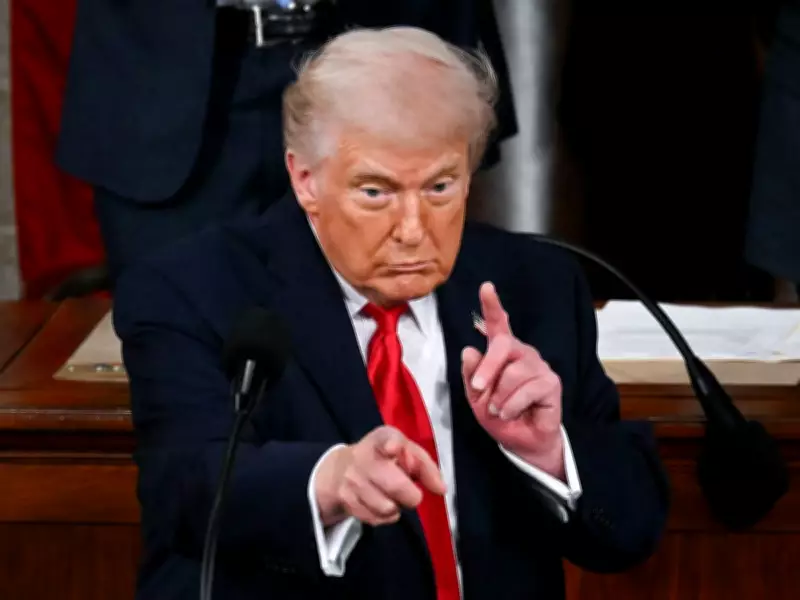
Trump's State of the Union Address Proclaims Economic Revival Amid Public Doubts
In a prime-time speech to a joint session of Congress, U.S. President Donald Trump offered a robust defense of his policies and economic achievements, aiming to bolster support for an agenda that has faced growing voter skepticism as midterm elections approach. The address, delivered on February 24, 2026, served as a pivotal moment for Trump's presidency, seeking a broad reset amid declining approval ratings and policy challenges.
A Defiant Declaration of National Strength
"Our nation is back bigger, better, richer and stronger than ever before," Trump declared during his State of the Union address. He emphasized a vision of American resurgence, stating, "You've seen nothing yet. We're going to do better and better and better. This is the Golden Age of America." To underscore this message, Trump invited the Olympic champion U.S. men's hockey team into the House chamber, where they displayed their gold medals as a symbol of victory.
The president painted a picture of a thriving nation, asserting, "Today, our border is secure, our spirit is restored. Inflation is plummeting, incomes are rising fast. The roaring economy is roaring like never before, and our enemies are scared. Our military and police are stacked, and America is respected again, perhaps like never before." He even quipped, "We're winning so much that we really don't know what to do about it," highlighting his confidence in the country's direction.

Confronting Political and Policy Headwinds
Despite Trump's optimistic rhetoric, the address comes at a critical juncture for his administration. Trump is grappling with falling approval ratings, multiple foreign policy flashpoints—including the threat of military action against Iran—and a significant setback to his signature tariff policy, which was recently struck down by the U.S. Supreme Court. These challenges threaten to undermine Republican control of Congress in the upcoming November midterm elections.
Public opinion polls reveal a stark contrast to Trump's assertions. A Washington Post-ABC News-Ipsos poll released just days before the speech showed that approximately 60% of Americans disapprove of Trump's job performance. Additionally, a new CNN survey indicated his approval rating among independents has plummeted to a mere 26%, reflecting widespread discontent.
Economic Narratives and Political Tensions
Rather than addressing the economic hardships faced by many Americans, such as squeezed household budgets, Trump shifted blame to his predecessor, President Joe Biden. He claimed to have "inherited a nation in crisis, with a stagnant economy, inflation at record levels, a wide open border, horrendous recruitment for military and police, rampant crime at home, and wars and chaos all over the world." This framing sets the tone for the midterm elections, where Democrats are energized by voter concerns over high prices and tariff impacts.
In response, the White House outlined plans to highlight job creation efforts, trillions in foreign and private investment pledges, and initiatives to curb rising costs, including for prescription drugs. Trump also championed proposals to restrict institutional investors from purchasing single-family homes and to force technology companies to bear more energy costs, urging congressional action on these fronts.
The Road Ahead for Trump's Agenda
Trump's State of the Union remarks, along with the Democratic response, are poised to shape the political landscape leading into the November elections. With Republicans' grip on Congress at risk, the address underscores the deepening divide between the president's portrayal of economic strength and the public's wary perception of his policies. As Trump seeks to reverse negative narratives, the coming months will test whether his message of a "richer and stronger" America resonates with voters or further fuels electoral challenges.