Trump's Greenland Ambitions Trigger NATO Crisis and European Retaliation Threats
President Donald Trump's aggressive push to acquire control of Greenland through sweeping tariff threats has plunged transatlantic relations into their most severe crisis in decades, with European leaders warning of a potential rupture capable of shattering the NATO alliance. The escalating confrontation over the Arctic territory has sent shockwaves through global markets and diplomatic circles, revealing deep fractures in Western unity.
European Leaders Push Back Against "Mistake" Tariffs
European Commission President Ursula von der Leyen delivered a stern rebuke to Trump's announcement of planned 10% import taxes on eight European nations supporting Denmark's sovereignty over Greenland. Speaking at the World Economic Forum in Davos, Switzerland, von der Leyen called the move a "mistake" and questioned Trump's trustworthiness, emphasizing that "when friends shake hands, it must mean something."
The EU's top official warned that plunging allies into a "downward spiral" would only benefit common adversaries, while vowing that Europe's response would be "unflinching, united and proportional." This marked a significant shift from the conciliatory approach many European leaders had adopted since Trump's return to office.

Trade "Bazooka" and Retaliatory Measures Considered
French President Emmanuel Macron raised the specter of unprecedented retaliation, suggesting the EU might deploy its powerful anti-coercion instrument—colloquially known as the "trade bazooka"—against the United States for the first time. This mechanism could sanction individuals or institutions found exerting undue pressure on the EU.
"Can you imagine that? This is crazy," Macron said in Davos, arguing that allied nations should instead focus on bringing peace to Ukraine. The French leader emphasized that the anti-coercion tool represents "a powerful instrument and we should not hesitate to deploy it in today's tough environment."
Market Turmoil and Diplomatic Fallout
The escalating tensions sent global investors into a panic on Tuesday, with Wall Street stocks slumping as the prospect of a deepening transatlantic trade war became increasingly real. The crisis has sparked outrage across European capitals, triggering a flurry of diplomatic activity as leaders consider countermeasures including retaliatory tariffs and potential suspension of the U.S.-EU trade deal.
Danish Prime Minister Mette Frederiksen warned that "the worst may still be ahead of us," while maintaining that Denmark has "consistently sought cooperation" rather than conflict. Greenland's Prime Minister Jens-Frederik Nielsen emphasized the need for "respect for international law and territorial integrity" during a news conference in Nuuk, stating plainly that "international law is not a game."
Trump's Unpredictable Approach and NATO Doubts
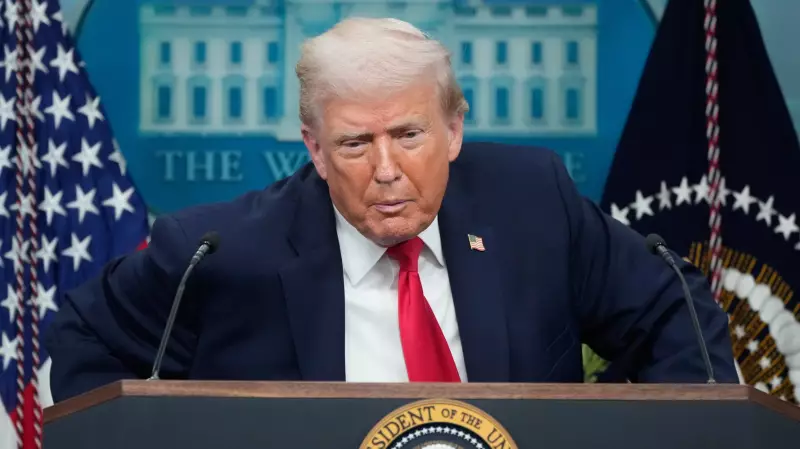
President Trump, who prides himself on negotiating from a position of strength, made an unusual appearance in the White House briefing room as markets fell. When asked how far he would go to acquire Greenland, Trump responded cryptically: "You'll find out." The president also mistakenly referred to Greenland as Iceland during his remarks.
Despite the tensions, Trump predicted a potential resolution, stating: "I think that we will work something out where NATO is going to be very happy, and where we're going to be very happy." However, he simultaneously belittled the alliance, questioning whether other members would come to America's defense despite expecting U.S. protection.
Broader Geopolitical Implications
The Greenland crisis has exposed fundamental disagreements about international order and alliance commitments. Canadian Prime Minister Mark Carney delivered a stark assessment in Davos, declaring: "Let me be direct: We are in the midst of a rupture, not a transition." He suggested the notion of a rules-based international order had become "illusion" and "fiction."
Belgian Prime Minister Bart De Wever asserted that Europe cannot be a "miserable slave to Trump," while California Governor Gavin Newsom criticized Europe's initial response as "pathetic" and "embarrassing," urging continental leaders to "stand tall and firm, have a backbone."

Meanwhile, Russian Foreign Minister Sergey Lavrov denied any intention by Russia and China to threaten Greenland, while describing the territory as a "colonial gain" for Denmark—adding another layer of complexity to the geopolitical standoff.
Military and Security Dimensions
Trump has justified his Greenland ambitions as necessary to deter potential threats from China and Russia in the strategically important Arctic region. In response, Greenland's European supporters have explored establishing a more permanent military presence to guarantee Arctic security—a key U.S. demand according to Swedish Defense Minister Pål Jonson.
The president's tariff threats specifically target eight European countries that deployed symbolic numbers of troops to Greenland last week, though Trump has also suggested the taxes serve as leverage in negotiations with Denmark over the territory's future.
Uncertain Path Forward
As Trump travels to Davos for the World Economic Forum—coinciding with the anniversary of his inauguration—the venue offers an opportunity to defuse tensions as quickly as they were ignited. However, European leaders appear determined to demonstrate "fierce resolve" in defending Denmark's sovereignty over semiautonomous Greenland.
When questioned about potential Supreme Court limitations on his tariff authority, Trump indicated he would simply "use something else" and employ "other alternatives," though he declined to specify what those might entail. The president's continued insistence that anything short of U.S. ownership of Greenland is unacceptable continues to test the limits of diplomatic engagement and threatens to redefine transatlantic relations for years to come.