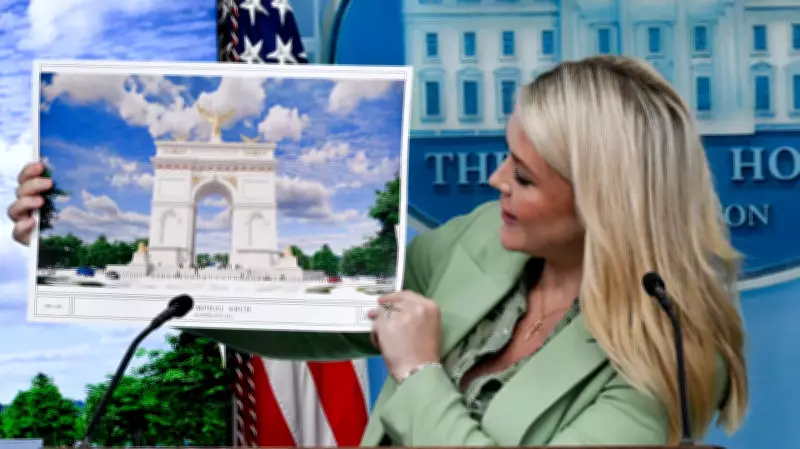
President Donald Trump's demand for a 22,000-square-foot ballroom has already stirred significant political trouble for congressional Republicans, but it may foreshadow an even larger issue: Trump's aspiration to construct a 250-foot-tall arch across the Potomac River from the Lincoln Memorial. Trump has attempted to dismiss questions about the legality and expense of his building spree, but ongoing lawsuits could compel the administration to seek congressional approval for both projects.
While a $1 billion funding request for the ballroom and the broader renovation of the East Wing has at least a veneer of security concerns to justify spending on presidential grandeur amid widespread economic discontent, Trump has admitted that the arch is merely a celebration of himself. Senate Majority Leader John Thune (R-S.D.) made an exasperated motorboat noise when asked about funding the arch. "That's not something we're contemplating here," Thune told HuffPost.
Court Battles Over the Arch
In court filings this year responding to a lawsuit that argues Trump cannot simply erect a giant arch—which would be the tallest in the world, dwarfing the Arc de Triomphe in Paris and twice as tall as the Lincoln Memorial—without congressional approval, the White House has indicated it could ask lawmakers to authorize construction by appropriating funds. "If such appropriations were enacted, they would provide additional 'express authority' to undertake construction," the Justice Department said in its initial response to the lawsuit in March. The administration reiterated that it "could request Congressional appropriations for the arch" in a filing last month, mirroring the approach taken with the ballroom.

White House spokesman Davis Ingle stated that the arch will be one of the world's most iconic landmarks. "It will enhance the visitor experience at Arlington National Cemetery for veterans, the families of the fallen, and all Americans alike, serving as a visual reminder of the noble sacrifices borne by so many American heroes throughout our 250-year history so we can enjoy our freedoms today," Ingle said in an email.
Legal and Political Ramifications
The ballroom and the arch may seem like a frivolous presidential side-quest to remodel the capital cityscape, but the underlying questions strike at the core of Trump's authoritarian ambitions in his second term: Can he do whatever he wants regardless of the law? And how far will Republicans go to assist him? A federal court ruled in March that the ballroom project, which began with the shocking demolition of the East Wing of the White House last fall, was clearly illegal. U.S. District Judge Richard Leon noted in his order blocking construction that Congress passed a law in 2002 explicitly forbidding the executive branch from building structures on federal property in D.C. without congressional approval. The case is currently under appeal.
The statute states: "A building or structure shall not be erected on any reservation, park, or public grounds of the Federal Government in the District of Columbia without express authority of Congress." Judge Leon emphasized that the White House simply needs to obtain authorization from lawmakers. This is partly why the White House pushed Republicans to allocate $1 billion despite Trump's boasts that the building would be privately funded. Republicans have added funding for the Secret Service and the "East Wing Modernization Project" to a bill originally intended to fund immigration enforcement operations within the Department of Homeland Security. They claim only 20% of the money would actually go toward construction.
Rep. Jamie Raskin (D-Md.) told HuffPost, "The cost of that should be zero, because it was only his bulldozing of the White House that created the necessity to rebuild it." Because Republicans are using a special budget process to pass the bill without needing Democratic votes in the Senate, the bill's provisions must have significant "budgetary effects" or risk being struck down by the Senate parliamentarian, a rules referee. Republicans could not simply add language authorizing the ballroom construction without attaching funding. It remains possible that the Senate parliamentarian will disallow the ballroom provision, and some Republicans seem hopeful that will happen, though senators could reword the proposal and try again.

Rep. Nick LaLota (R-N.Y.) told HuffPost, "People are choosing their words carefully, but most of us are under that assumption that this initiative is going to die, because a lot of folks think that $200 million towards the ballroom at a time where Americans were paying $4.50 for gas, those two things don't mix."
The Arch's Unique Legal Challenges
The arch may present an even trickier legal question for the White House than the ballroom. In addition to the law preventing construction on federal grounds in Washington without congressional approval, the Commemorative Works Act, enacted in 1986, governs how memorials can be built in the city. This law specifically requires congressional authorization in the area where Trump wants his arch. The Trump administration has argued to U.S. District Judge Tanya Chutkan, who is hearing the arch case, that the government does not need approval because—remarkably—"Congress has already authorized construction of two tall columns surmounted by statues" at the site. This supposed prior authorization stems from a law passed in 1913, over a century ago, creating an Arlington Memorial Bridge Commission tasked with reporting on a bridge design across the Potomac River. The two tall columns were never built.
The Justice Department also contended that construction has not started, so the court cannot issue an injunction, and Judge Chutkan declined to do so last month for that reason. Instead, the judge ruled that the National Park Service cannot build before providing public notice of its authorization and must give two weeks' warning before starting construction. Nicolas Sansone, an attorney with Public Citizen, which brought the case on behalf of four Vietnam veterans, told HuffPost, "Obviously, when we get that notice, I think it's no secret we're going to rush right back into court and renew our motion for a preliminary injunction." Heavy machinery was at the proposed site this week for preliminary work, and emails obtained by the Washington Post show the White House envisioned using an existing contract to start work. Nevertheless, Interior Secretary Doug Burgum told lawmakers this week, "there's been no final agency action around building something on a site."
Rep. Jared Huffman (D-Calif.), the top Democrat on the House Natural Resources Committee, said in a video from the worksite, "Clearly, we're being snookered here. It seems to be the East Wing demolition all over again, where they just plow ahead without asking permission, without following the law." Sen. Chuck Grassley (R-Iowa), chair of the Senate Judiciary Committee, which added the ballroom money to the immigration enforcement bill, suggested to HuffPost that there are no firm plans for an arch. "That's just talk now, let's wait and see if it advances," Grassley said.
If Republicans hope to avoid the issue entirely, they will have to convince Trump to abandon one of his apparent obsessions. A model of the arch has been repeatedly spotted on Trump's desk in the Oval Office. When a reporter asked him in October who the arch would be for, Trump was perfectly honest. "Me," he said.