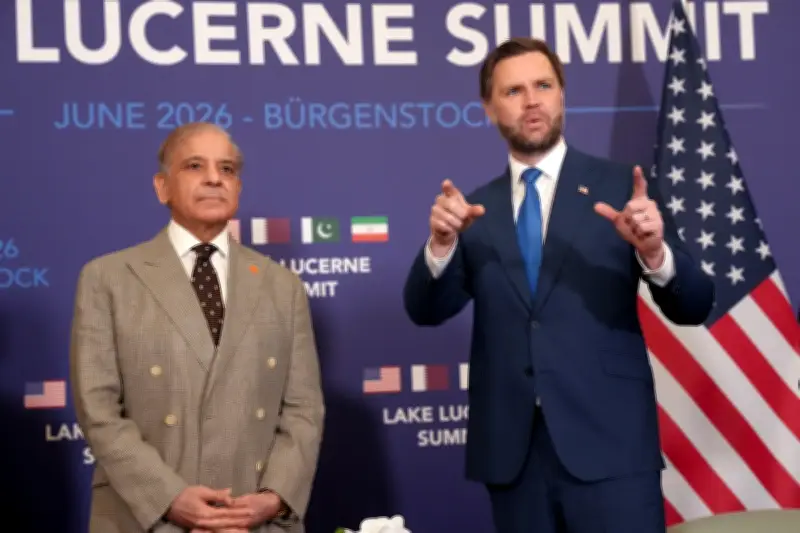
Former President Donald Trump has threatened to 'hit Iran very hard again' over its support for the Lebanese militant group Hezbollah, according to a statement released on June 21, 2026. The threat comes as U.S. Vice President JD Vance and senior Iranian officials arrived in Switzerland on Sunday to formally launch negotiations over Tehran's nuclear program.
Escalating Rhetoric Amid Nuclear Talks
Trump's warning, issued via a press release, did not specify what actions he would take but referenced previous military strikes against Iranian-backed forces during his administration. 'Iran must stop its support for Hezbollah and other terrorist organizations, or it will face severe consequences,' the statement read. 'We will hit them very hard again, just like before.'
The timing of the threat coincides with the start of nuclear negotiations in Geneva, where Vice President Vance is leading the U.S. delegation. Vance's office declined to comment on Trump's remarks, stating only that 'the Vice President is focused on achieving a verifiable and enforceable agreement that prevents Iran from obtaining a nuclear weapon.'

Background on US-Iran Tensions
Relations between the United States and Iran have been strained for decades, with disputes over Iran's nuclear program, its support for proxy groups like Hezbollah, and human rights issues. Under the Trump administration, the U.S. withdrew from the 2015 Joint Comprehensive Plan of Action (JCPOA) and imposed crippling sanctions on Iran. In 2020, Trump ordered a drone strike that killed Iranian General Qasem Soleimani, escalating tensions further.
Since then, Iran has enriched uranium to near weapons-grade levels, according to the International Atomic Energy Agency (IAEA). The Biden administration had sought to revive the nuclear deal but talks stalled in 2024. Current negotiations aim to establish a new framework limiting Iran's nuclear activities in exchange for sanctions relief.
International Reactions
European Union foreign policy chief Josep Borrell called for restraint, saying 'threats and counter-threats are not conducive to productive negotiations.' He urged all parties to engage in good faith. Iranian Foreign Minister Abbas Araghchi responded by stating that Iran 'will not bow to threats' and that its support for Hezbollah is 'non-negotiable.'
Meanwhile, analysts warn that Trump's rhetoric could undermine the talks. 'Every time someone makes a bellicose statement, it reduces the chances of a diplomatic solution,' said Dr. Sarah Kreps, a professor of international relations at Cornell University. 'The Iranian negotiators will be less willing to make concessions if they believe the U.S. might attack them regardless.'
Impact on the Region
Hezbollah, which is designated as a terrorist organization by the U.S. and many Western countries, has been a key Iranian ally in Lebanon and Syria. The group has fought alongside Syrian government forces and has a large rocket arsenal aimed at Israel. Israeli Prime Minister Naftali Bennett welcomed Trump's statement, saying 'Israel supports any action that curbs Iranian aggression.'
In Lebanon, where Hezbollah is a major political force, the threat has raised fears of renewed conflict. 'We are already in an economic crisis, and another war would be catastrophic,' said Rami Khouri, a Lebanese journalist. 'The international community must step in to de-escalate.'
The negotiations in Switzerland are expected to continue for several days, with both sides expressing cautious optimism. However, Trump's intervention has cast a shadow over the proceedings, highlighting the deep divisions within U.S. politics over how to handle Iran.