Trump's Davos Address Sparks Controversy with 'Daddy' Remark and NATO Critique
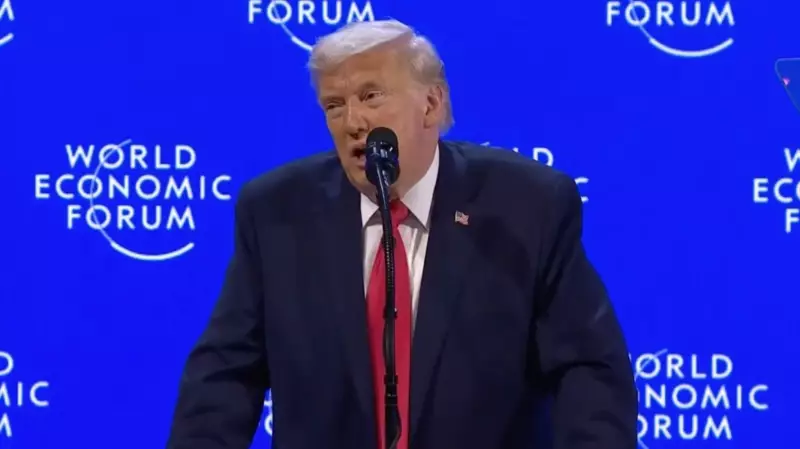
In a speech that blended geopolitical commentary with personal boasts, former U.S. President Donald Trump made headlines at the World Economic Forum 2026 in Davos, Switzerland, on Wednesday. The right-wing leader claimed that Europeans refer to him as "daddy" while delivering a pointed critique of NATO's reliability and discussing ongoing efforts to broker peace between Russia and Ukraine.
Ukraine Peace Talks and European Relations
Trump opened his remarks by addressing the conflict in Eastern Europe, stating that he has been actively engaged with both Ukrainian President Volodymyr Zelenskyy and Russian President Vladimir Putin. He expressed optimism that both leaders "want to make a deal" to end the war, emphasizing the human cost of the ongoing hostilities. "Too many people are dying, needlessly dying," Trump asserted. "Too many souls are being lost. It's the only reason I'm interested in doing it."
Transitioning to European affairs, Trump boasted about his perceived influence, claiming that "they loved me" until his controversial attempt to annex Greenland—a move he mistakenly referenced as involving Iceland. It was in this context that he made the eyebrow-raising comment about being called "daddy" by Europeans. "They called me 'Daddy,' right? The last time? [A] very smart man said, 'He's our daddy. He's running it,'" Trump recounted without identifying the individual. "I was, like, running it. I went from running it to being a terrible human being."

Greenland Annexation and NATO Tensions
Trump's long-standing ambition to control Greenland has been a source of friction with European allies, who argue that such an annexation would severely undermine NATO's cohesion. In response to pushback, Trump had previously threatened to impose tariffs on countries opposing his Greenland bid. However, in a surprising reversal during his Davos speech, he walked back those tariff threats, framing his desire for the territory as a modest request. "Now what I'm asking for is a piece of ice, cold and poorly located that can play a vital role in world peace and world protection," he stated, calling it "a very small ask compared to what we have given them for many, many decades."
Criticism of NATO's Commitment
The core of Trump's address focused on his skepticism toward NATO, questioning whether member nations would reciprocate U.S. support in a crisis. "The problem with NATO is the U.S. will be there for them 100%, but I'm not sure that they'd be there for us if we gave them the call," he argued. Trump dramatized a hypothetical scenario, mimicking a call for help: "'Gentlemen, we are being attacked. We're under attack by such and such a nation.' I know them all very well. I'm not sure that they'd be there. I know we'd be there for them. I don't know that they would be there for us."
This critique overlooks NATO's historical actions, such as invoking Article 5—the collective defense clause—in support of the United States following the September 11 attacks. Trump dismissed this precedent, alleging, "So with all of the money we expend, with all the blood, sweat and tears, I don't know that they'd be there for us." He further blamed Iceland, in another reference to his Greenland confusion, for economic woes, claiming, "I mean our stock market took the first dip yesterday because of Iceland. So Iceland's already cost us a lot of money."
Trump's speech at Davos thus wove together personal anecdotes, geopolitical negotiations, and sharp criticism of international alliances, highlighting his unconventional approach to foreign policy and ongoing tensions with European partners.