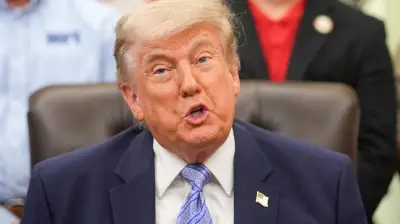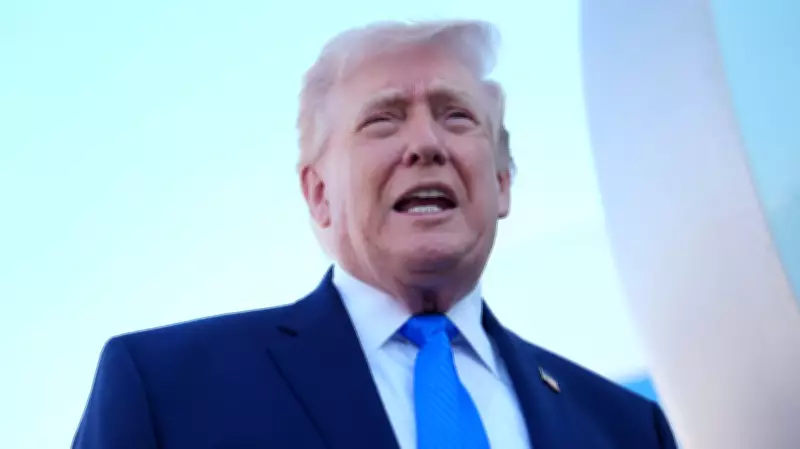
President Donald Trump launched a sharp verbal attack against a Newsmax reporter on Monday, cutting off the journalist as he attempted to inquire about Immigration and Customs Enforcement agents being dispatched to airports. This deployment is occurring amidst an ongoing battle over Homeland Security funding, adding a layer of urgency to the questioning.
A Public Rebuke and Interruption
The confrontation began when the Newsmax correspondent started to pose his question. Trump immediately interrupted, demanding to know which publication the reporter represented. Upon learning it was Newsmax, a media outlet typically favored by the conservative president, Trump did not hold back.
"You’re not doing a very good job," Trump told the reporter bluntly. When the journalist tried to persist with his line of inquiry, Trump interrupted once more, reinforcing his criticism. "You’re not doing a good job. Did you hear me?" the president stated, making his displeasure unmistakably clear to everyone present.

Choosing CNN Over a Traditional Ally
In a move that underscored the shifting dynamics, Trump then pointedly directed a CNN reporter to ask the next question. "Can you believe it? I’m taking CNN over Newsmax," Trump remarked with evident sarcasm. "Can you believe it?" This public snub of a normally supportive outlet sent a strong message about the president's current media relations strategy.
After fielding several questions from other reporters, Trump circled back minutes later to further insult the Newsmax journalist. While pointing at the reporter, Trump commented to another journalist, "I don’t think he’s going to be at Newsmax long," suggesting potential professional repercussions for the individual.
A Pattern of Hostility Toward the Press
Newsmax, which did not provide an immediate response to requests for comment, has historically been a conservative voice sympathetic to Trump. However, this incident is not an isolated one. Trump has long positioned himself as an opponent of the mainstream free press, but his second term has seen a notable escalation in his habit of lashing out at reporters, with a particular focus on female journalists.
The president's history of contentious interactions includes:
- Last year, after reporter Catherine Lucey pressed him about his relationship with convicted sex trafficker Jeffrey Epstein, Trump ordered her to stop with a crude insult: "Quiet, piggy."
- Approximately a month later, Trump told ABC’s Rachel Scott that she was the "most obnoxious reporter in the whole place."
- He publicly scolded CNN’s Kaitlan Collins for not smiling and called her "Stupid and Nasty" on social media platforms.
- Trump has also described The New York Times’ Katie Rogers as "ugly, both inside and out," and labeled ABC News’ Karen Travers as "very loud."
Administration Officials Follow Suit
This adversarial stance is not confined to the president alone. Officials within the Trump administration have been observed following his lead, applying pressure on news organizations to align more closely with the administration's perspectives.
Just last week, Federal Communications Commission Chair Brendan Carr publicly urged television networks to broadcast more "patriotic" and "pro-America" programming. Carr emphasized the need for content that highlights the nation's positive achievements, a directive seen by many as an attempt to influence editorial independence.
Earlier this month, Defense Secretary Pete Hegseth invoked a significant media deal during a Pentagon press briefing. He referenced billionaire Trump ally David Ellison's agreement to acquire CNN's parent company, Warner Bros. Discovery, which was finalized in late February. Hegseth taunted the network by stating, "the sooner [Ellison] takes over ... the better." David Ellison is the son of Larry Ellison, another prominent Trump supporter.

This acquisition has sparked considerable concern within CNN's newsroom. Many journalists and staff members worry that the new ownership could compromise their ability to produce independent, critical reports about the Trump administration, potentially undermining journalistic integrity and press freedom.