The U.S. Supreme Court on Friday rejected a request by Virginia Democrats to revive a voting map that was designed to help their party gain control of the U.S. House of Representatives in the November midterm elections. The justices declined to halt a ruling by Virginia's top court that blocked the voter-approved pro-Democratic map.
Background of the Redistricting Battle
The map, crafted to flip four Republican-held House seats to Democrats, was part of a nationwide political battle initiated by President Donald Trump to redraw electoral district boundaries for partisan advantage. The conservative-majority Supreme Court's decision follows a similar move on Monday, when it cleared the way for Alabama Republicans to pursue a congressional map favorable to their party.
Control of Congress is at stake in the midterms, with Republicans holding slim majorities in both the House and Senate. Virginia has 11 seats in the 435-member House.

Virginia Supreme Court Ruling
The Virginia Supreme Court, in a 4-3 decision on May 8, threw out the state's voter-approved map, ruling in favor of Republicans who challenged it. The court found that Democratic lawmakers had not followed proper procedures last year when they rushed to approve the referendum in the state legislature in time for the ballot initiative.
Don Scott, speaker of the Virginia House of Delegates, and other Democratic legislators asked the U.S. Supreme Court to halt the ruling, arguing it had “deprived voters, candidates and the Commonwealth of their right to the lawfully enacted congressional districts.” They cited a 2023 Supreme Court ruling that state courts may not overstep their bounds in regulating federal elections.
Mid-Decade Redistricting
Redistricting traditionally occurs every 10 years after the U.S. census to reflect population changes. However, the current mid-decade fight is unusual. At Trump's urging, Republican-led Texas redrew its map to target five Democratic-held seats, prompting Democratic-led California to reconfigure its map to target five Republican-held seats. Multiple other states have joined the fray.
Democrats suffered a blow in April when the Supreme Court's 6-3 conservative majority gutted a key provision of the Voting Rights Act, allowing Republican-led Southern states to dismantle Democratic-held majority-Black and majority-Latino districts. Black and Latino voters tend to support Democratic candidates.
Virginia Referendum
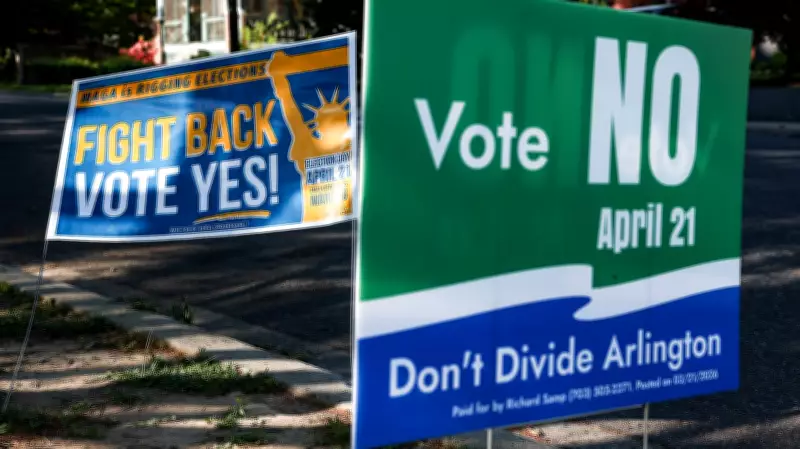
Virginia voters approved the Democratic-backed map in an April 21 special election by a 51.7% to 48.3% margin, with about 3.1 million votes cast. The referendum was the final step in a legislative maneuver to bypass a 2020 constitutional amendment that had placed redistricting in the hands of a bipartisan commission.
Underscoring the stakes, Democratic- and Republican-affiliated groups spent close to $100 million on the referendum campaign.