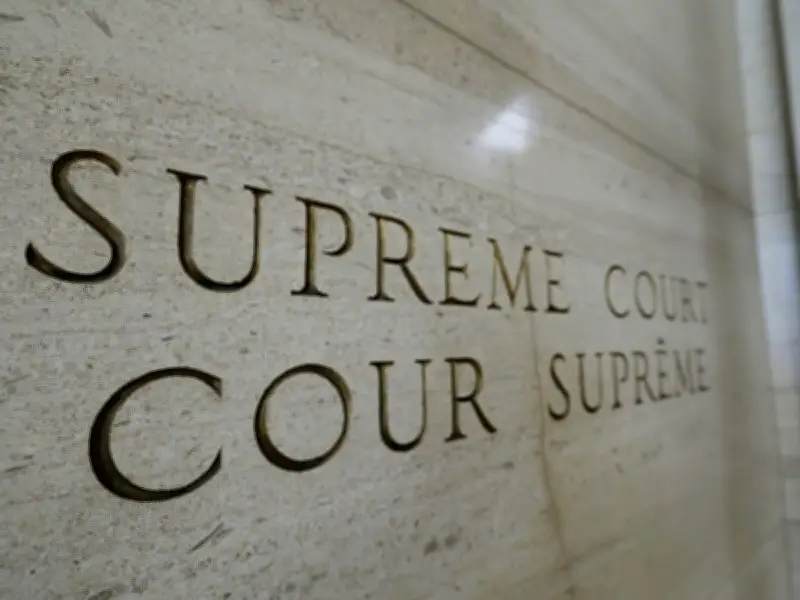
Former Supreme Court Justice Jack C. Major warns that the expansion of judicial power under the Charter of Rights and Freedoms has eroded Canada's parliamentary democracy, and he calls on legislatures to reassert their authority.
Charter's unintended consequences
The 1982 enactment of the Charter was hailed as a landmark moment, but critics at the time warned it would weaken Canada's Westminster-style parliamentary democracy inherited from Britain. Major argues those warnings have been vindicated by recent Supreme Court decisions.
In a foreword to a new Macdonald-Laurier Institute paper by legal scholars Geoff Sigalet, Kerry Sun and Yuan Yi Zhu, Major says the expansion of judicial power under the Charter has upset the balance between political and judicial authority. The paper details how courts have gradually expanded their role into areas once left to legislatures.

Shift in constitutional balance
Canada's system of responsible government, established before Confederation, gives elected representatives primary responsibility for policy and lawmaking. However, over decades, the judiciary has assumed greater power through broad interpretations of the Charter, particularly Section 7, which guarantees life, liberty and security of the person.
Major notes that this has drawn courts into socioeconomic policymaking on issues from drug addiction treatment to climate change and urban planning. The authors criticize the "living tree" approach to constitutional interpretation, arguing it has narrowed democratic decision-making in areas like labour relations.
Structural problems identified
The paper tracks jurisprudential developments that depart from the 1867 constitutional settlement and even the framers' intent in 1982. Some departures lack compelling reasons, and others have no reasons at all. The authors conclude these are not isolated instances but symptoms of structural problems in judicial interpretation.
The result, Major says, is an informal modification of the Canadian constitution, shifting authority from legislatures to courts without the input of Parliament or provinces as required by the amending formula. He urges legislatures to push back to restore constitutional balance.