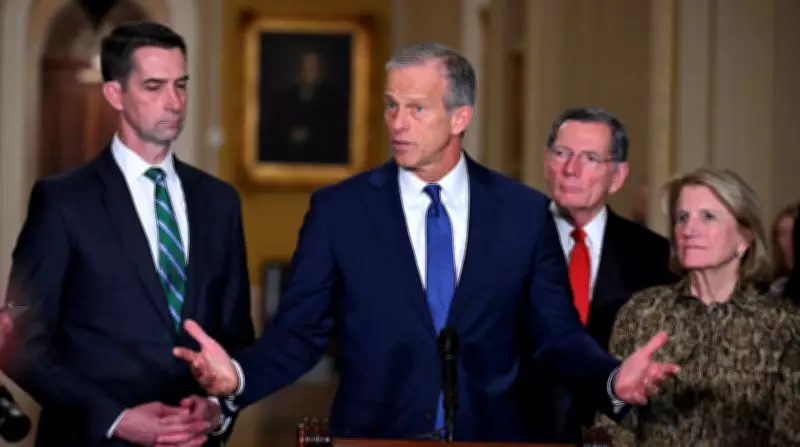
In a significant political move, Senate Republicans voted on Tuesday to commence floor debate on President Donald Trump's ambitious plan to nationalize elections and severely curtail mail-in voting. Trump and his allies have framed the legislation, known as the SAVE America Act, as a critical measure to prevent a Republican defeat in the upcoming November midterm elections. However, the bill's prospects are dim due to steadfast Democratic resistance and a lack of consensus among Republicans on procedural tactics.
Legislative Hurdles and Internal Divisions
The sweeping proposal faces a steep climb to enactment, as Democrats in the Senate are united in their opposition, and several Republican senators have expressed reluctance to eliminate the filibuster to advance it. Senator Lisa Murkowski, a Republican from Alaska, voiced her concerns on Tuesday, stating, "I'm not prepared to go down this uncertain and ill-defined path that we're looking at." She highlighted that the bill would likely disenfranchise voters in her rural state and noted it lacks the necessary 60 votes to overcome a filibuster, effectively dooming its passage.
Key Provisions of the SAVE America Act
The legislation mandates that voters provide proof of citizenship during registration and present photo identification at polling places. It also aims to eliminate mail-in voting except in limited circumstances. Additionally, Trump has insisted on including a ban preventing transgender athletes from competing in women's sports. On Tuesday, the former president escalated his rhetoric, urging Republicans to pass the bill by any means necessary or risk electoral repercussions.

In a fiery post on his social media platform, Truth Social, Trump declared, "Only sick, demented, or deranged people in the House or Senate could vote against THE SAVE AMERICA ACT. If they do, each one of these points, separately, will be used against the user in his/her political campaign for office - A guaranteed loss!"
Democratic and Republican Responses
When questioned about Trump's threats, Senate Majority Leader John Thune of South Dakota responded cautiously, telling reporters, "I prefer to have our fights with Democrats." He emphasized the importance of maintaining Republican control in the Senate, adding, "We may not agree on everything, but I'm way more in favor of ensuring that we have Republicans holding these seats in the U.S. Senate than handing them to Democrats."
Democrats and voting rights advocates have raised alarms, arguing that the bill could disenfranchise millions of Americans by imposing stringent citizenship and ID requirements, which many lack readily available documentation. They also point out that the measures would disproportionately burden married women, who often change their last names legally after marriage.
Schumer's Strong Condemnation
Senate Minority Leader Chuck Schumer of New York condemned the legislation, stating, "It's not a voter ID bill. It is a voter suppression bill." He vowed that Democrats would remain united in blocking it. Schumer further accused Trump of attempting to "steal" the midterm elections by altering voting rules rather than addressing policy issues amid widespread voter dissatisfaction with the economy and the conflict in Iran.
"He knows his [poll] numbers are in the gutter. What does he want to do? He wants to cheat ... He knows that without rigging the game, he is in trouble," Schumer asserted. Notably, even Senator John Fetterman, a Democrat from Pennsylvania who has occasionally aligned with Trump, opposes the bill due to its restrictions on mail-in voting, which he described as "absolutely secure." Many Republican senators also reject Trump's unfounded claims of widespread voter fraud.
Extended Debate and Strategic Maneuvers
The debate over the SAVE America Act is expected to prolong into next week, potentially involving late-night sessions and weekend work. Proponents like Senator Mike Lee of Utah advocate for continuous debate without recess until the bill is resolved, a stance Trump supports. However, Democrats are prepared for an extended fight, with some planning to force votes on ending the war in Iran as a stalling tactic.

Republicans are not fully unified on the issue, with several members opposing the bill outright. The idea of canceling recess and dedicating extensive floor time to a measure with little chance of success is unappealing to many. Senator Murkowski summarized the uncertainty, telling reporters, "We're not quite sure how much floor time it will take up, but right now, it appears that it's almost unlimited."
As the political drama unfolds, the SAVE America Act remains a focal point of contention, highlighting deep divisions within the Republican Party and setting the stage for a protracted legislative battle that could shape the upcoming election cycle.