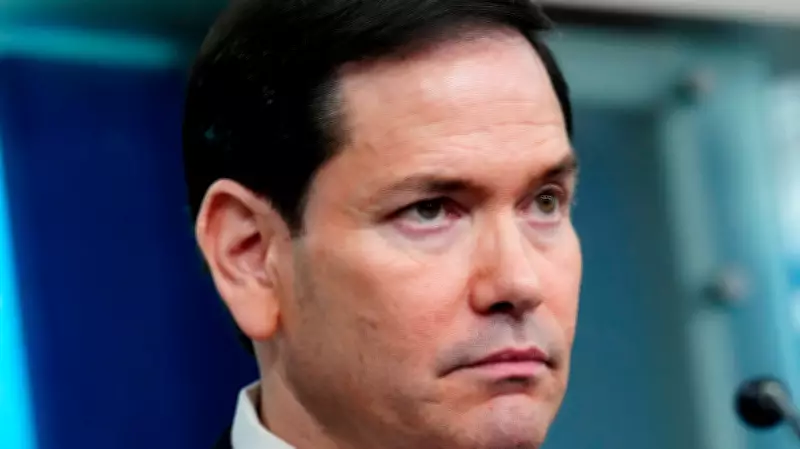
Secretary of State Marco Rubio appeared alarmed that Iran would shut down the Strait of Hormuz after the United States initiated a war with the country. Speaking to reporters at a White House press briefing on Tuesday, Rubio boasted about the destruction of Iran's military while acknowledging that Iran still maintains complete control over the Strait of Hormuz, a critical international shipping lane whose closure has impacted the global economy.
Rubio's Warning on International Shipping Lanes
“If we live in a world where a rogue state like the Iranian regime is allowed to claim control of an international shipping lane as a new normal, it will not be long before you see that happen in multiple shipping lanes around the world,” Rubio warned. “I can identify six or seven vital shipping lanes globally where some countries might decide, ‘Guess what? If Iran did it, we will too. We will start charging tolls.’ This will come closer to us, and it is unacceptable.”
Rubio omitted that this problem would not exist if President Donald Trump had not decided to go to war with Iran in February. Before the bombings, the strait—a major artery for the world's oil supply—was open. Now, Iran has blocked the strait and is charging substantial tolls for ships to pass through.

Impact on the US Economy
Rubio acknowledged the negative impact on the U.S. economy. “The goods we manufacture and export in this country must travel through international shipping lanes,” Rubio said. “Living in a world where a country can decide, ‘Now we own the international shipping lane and you must pay us to use it,’ is a normal we can never accept.”
His comments appeared to contradict Defense Secretary Pete Hegseth, who insisted on Tuesday that Iran does not control the Strait of Hormuz. “Two U.S. commercial ships, along with American destroyers, have already safely transited the strait, proving the lane is clear,” Hegseth stated. “We know the Iranians are embarrassed by this fact. They claim they control the strait, but they do not.”
As of Tuesday, traffic in the strait remains a tiny fraction of pre-war levels. Despite Iran's control, Rubio argued that the situation would be even worse if Iran possessed a nuclear weapon. “If Iran had a nuclear weapon and decided to close the straits, causing gas prices to reach $8 or $9 per gallon, we would be powerless because they would have nuclear capabilities. A nuclear-armed Iran could do whatever it wants with the straits, and no one could stop them.”
Even without nuclear weapons, Iran appears to be acting unilaterally. When asked about rising gas prices in the U.S., Rubio reassured Americans not to worry, noting that gas prices are higher elsewhere. “If you look, it is obviously driven by global events,” Rubio said of the global events triggered by the U.S. “We do not benefit from the straits as much as other countries. I do not know if you have seen gas prices in other parts of the world that are truly suffering—big time.”