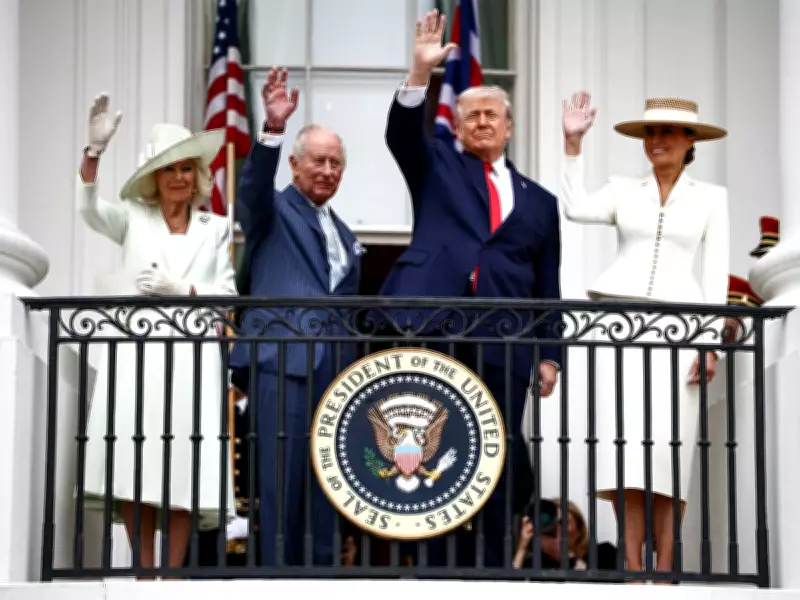
King Charles III made America sound older than 250 during his visit this week to Washington, D.C., in advance of the semiquincentennial anniversary of the U.S. Declaration of Independence on July 4. In his speech to Congress on Tuesday, His Majesty joked that Britain and America shared everything but language. President Donald Trump replied with his own banter and royal compliments during a state dinner that evening.
More notably, in a speech welcoming the King and Queen Camilla earlier in the day, Trump praised the “small but mighty kingdom from across the sea” that bequeathed to America, among other strengths, its Anglo-Saxon courage. Intentional or not, it was a high-profile rebuttal of the notion that the United States is an abstract “melting pot” and a nation of propositional “ideas.”
Trump spoke the truth, if only as a matter of historical fact. The American Revolution was not a total rejection of Britain; even during the Revolutionary War itself, les Canadiens in the recently conquered Province of Quebec saw it as a British civil war. Indeed, America’s founding vocabulary, democratic institutions and literature were distinctly and consciously British. From New England to Pennsylvania to Virginia to the Carolinas, generations of Englishmen and Scotch-Irish settlers helped establish a distinctly British character on the continent. Whether in the ethos of self-government, Protestant morality, or suspicion of arbitrary power, it all had its roots in Magna Carta, the Reformation, and the English Civil War.

The American Revolution itself was not understood by its leaders as a radical revolt, but as a legal and logical resistance to violations of their English liberties, such as the principle of “no taxation without representation.” The American rebels fought the Crown and parliament in London for their perceived betrayal of the English constitution. When the Revolutionary War was won, the American colonial stock did not reject its heritage simply because it had ceased to be the King’s subjects.
For about the first century of the republic, Anglo-America was dominant, notwithstanding the presence of small minorities of Germans, Dutch and others. The largest minority was Black Americans in the South, most of them enslaved and therefore excluded from formal political power, despite their unmistakable impact on American culture, cuisine and religion. Nearly all Americans still spoke only English and lived by the English common law. The frontiersman and the cowboy, strong individuals who earned their living by their own efforts, were part of this tradition.
In 1916, as the effects of mass immigration to America truly began to take hold, Theodore Roosevelt denounced “hyphenated Americanism” and demanded that immigrants become “Americans, and nothing else.”