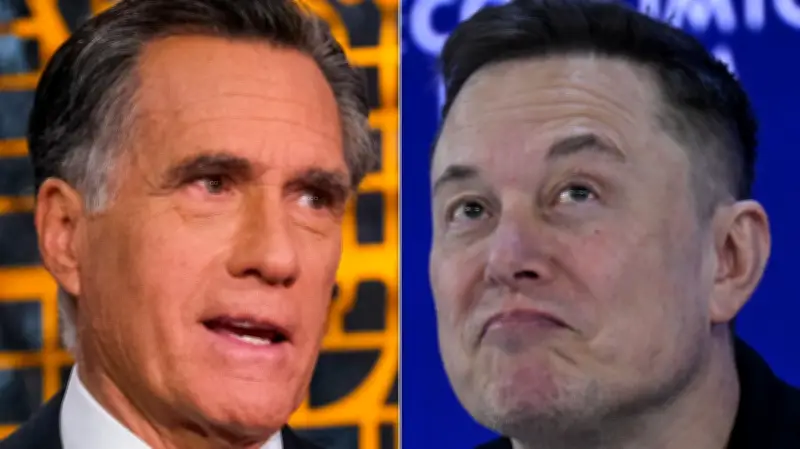
Former Republican presidential candidate and ex-senator Mitt Romney admitted he is worried about the growing concentration of wealth and its impact on money in politics. In a recent podcast interview, Romney highlighted the case of tech mogul Elon Musk, who was recently minted as the world's first trillionaire.
Romney's Concerns About Extreme Wealth
Speaking to journalist McKay Coppins on the Deseret Voices podcast, Romney said, “I’m concerned about the amount of money a few people are getting.” He then tried to contextualize Musk's fortune, noting, “The idea that Elon Musk is going to be a trillionaire… I mean, what does that mean? We’re talking about 1,000 billions.”
Romney, whose own net worth is estimated at over $200 million, warned that such immense wealth could be used to dominate political campaigns. “That means he could drop a couple billion on a political campaign to support someone who would give him even more power,” he said, referring to Musk.

Musk's Political Influence
Romney pointed out that Musk reportedly donated more than $290 million to President Donald Trump’s 2024 campaign and supporting super PACs. Musk's backing earned him a role in the White House as the head of the now-defunct Department of Government Efficiency, which aimed to slash budgets. Romney noted that Musk is not alone in wielding such economic power, adding, “He’s not the only one; I shouldn’t just pick on him,” as many wealthy individuals can influence the political system.
Regulatory Conflicts and Wealth Concentration
By pushing for downsizing agencies that regulated his enterprises, such as the Department of Labor’s Office overseeing federal contracts, Musk was able to reduce audits and investigations into workplace violations at Tesla. Last month, Musk became a trillionaire after taking SpaceX public. He is now among the thousands of individuals who hold one-fifth of the world’s annual economic output, according to The New York Times.
Romney's Previous Advocacy for Taxing the Rich
Romney previously addressed the threats posed by ultra-wealthy individuals in a 2025 New York Times op-ed titled “Tax the Rich, Like Me.” He argued that tax laws are shaped to favor the rich, writing, “It is not that the rich, in these cases, are cheating the government; they are playing by the rules. But given the potential peril ahead, we need to follow the Willie Sutton rule: Go where the money is.”